

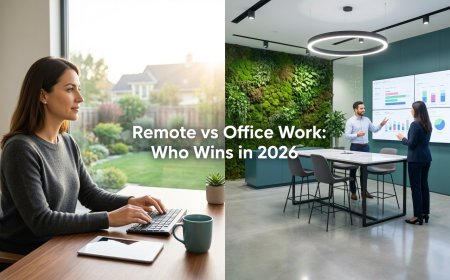











































































































































































































Remote vs Office Work: Who Wins in 2026 Trends Now
Explore remote, office, and hybrid work trends in 2026.. Learn what employees prefer, why companies push office returns, and how businesses balance flexibility!
1.
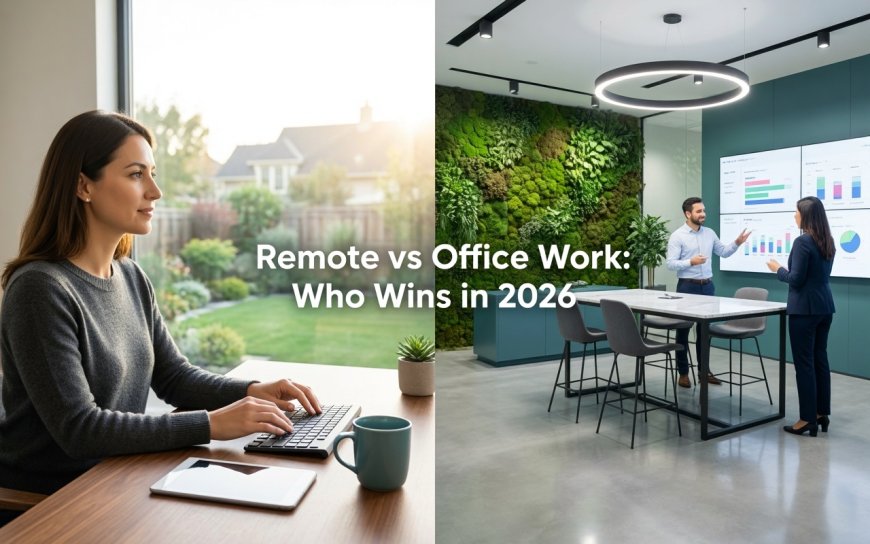
In the past few years, the way people work has changed more than it did in the previous several decades. What began as a sudden shift during the pandemic has now turned into a major discussion in businesses everywhere. Today, companies and employees are asking one big question: Should we work from home, come back to the office, or use a mix of both
Remote work was once seen as a temporary convenience. But now, it has become a long-term part of how many organisations operate. However, in 2026, a strong trend is emerging for the return to office work. While many employees still value flexibility, businesses are pushing for more in-person collaboration. Let’s explore what’s really going on.
How Remote Work Became Important
Remote work became mainstream because it offered real benefits. Workers saved time and money by avoiding long commutes. They were able to balance work with family responsibilities. At the same time, companies reduced costs on office space and reached talent outside their city or country.
In India, remote and hybrid work have become common. Recent data shows that about 12.7% of full-time employees work fully from home, and 28.2% follow a hybrid model, which means working partly from home and partly from the office. This change reflects a shift in employee expectations and workplace flexibility.
Even as things open up again, remote work has not disappeared. It is now a key part of many job arrangements and remains attractive for both workers and employers.
2. Why Some Companies Want Employees Back in the Office

Despite remote work’s popularity, many companies are now encouraging employees to return to the office either full-time or on a hybrid schedule.
Here are the main reasons businesses are pushing for this change:
-
Better collaboration and communication: When teams are together in one place, ideas can flow more freely. Quick discussions at desks or in meeting rooms often solve problems faster than group calls can.
-
Stronger company culture: Being physically present helps new employees learn the company’s values, habits, and work style. It also strengthens relationships between team members.
-
Faster decision-making: When leaders and workers are in the same space, decisions can be made quickly without waiting for time zone overlaps or scheduling conflicts.
-
Training and onboarding: In-person training gives new employees more support and clearer guidance.
Because of these reasons, many major companies in India have updated their work policies. Some now ask employees to be in the office at least a few days each week.
This shift is not limited to one sector. Large corporate firms and IT companies are leading the move toward more office time.
3. Hybrid Work: The Most Common Model Now
Although some companies are pushing for full office returns, most workplaces are not returning to old-style full-time office work. Instead, hybrid work has become the most common solution.
Recent industry surveys point out that:
-
About 27% of companies expect employees to be in the office full-time.
-
Around 67% are offering hybrid work options.
In India, many companies now use schedules like:
-
Office days on Tuesday, Wednesday and Thursday
-
Work-from-home on Monday and Friday
This kind of balance allows organisations to maintain some personal interaction while still giving workers flexibility
What Employees Really Prefer
Employees have now experienced both remote work and office routines. Many have formed strong opinions about what works best for them.
Here are the top preferences from workers across India and globally:
-
Flexible working hours: Most employees like being able to manage their time, especially for personal responsibilities.
-
Reduced travel time: Long commuting often affects physical and mental health. Avoiding it saves money, too.
-
Better balance between life and work: People are placing more value on time with family and personal well-being.
-
Opportunities to work remotely when needed: Even employees who enjoy going to the office don’t want strict attendance rules.
These preferences are strong enough that some workers are willing to leave jobs that require full-time office attendance. This puts companies in a position where they must balance business needs with worker expectations.
The Changing Work Environment in 2026
Work culture in 2026 is not fixed. It continues to change based on how businesses operate, what employees want, and overall economic conditions.
Here are some important trends shaping work today:
-
Focus on results rather than hours: Many companies now measure performance by what is delivered, not by how many hours someone spends at a desk.
-
Smaller, smarter office spaces: Some businesses are reducing office size and redesigning spaces for collaboration and meetings.
-
Work across cities and borders: Teams are often spread across states or even countries, which makes hybrid models more practical.
Experts now say that remote work is not just a trend but a permanent part of the work landscape.
The Pros and Cons of Each Model
Remote Work: Key Benefits
-
Work-life balance improves
-
Savings on transport and food costs
-
Flexibility to work from anywhere
-
Access to jobs outside of your city
Remote Work: Main Challenges
-
Communication can be slower or less clear.
-
Some team members may feel isolated.
-
Less immediate support for problem-solving
-
Concerns about protecting company information
Office Work: Key Benefits
-
Faster communication and teamwork
-
Clearer learning opportunities for new employees
-
Strong workplace culture
-
Higher chances of spontaneous idea sharing
Office Work: Main Challenges
-
Longer travel time and extra cost for employees
-
Rigid time schedules
-
Work-life balance can suffer.
-
Less flexibility for personal needs
4. A Balanced Approach: Smart Hybrid Work
Based on current trends, businesses are choosing hybrid plans that combine the best parts of both worlds. Here are some approaches companies are taking:
-
Setting specific days for teamwork and meetings
-
Allowing remote days for focused tasks
-
Offering flexible schedules based on job roles
-
Measuring employees by results, not attendance
This approach allows businesses to benefit from face-to-face interaction without forcing employees into rigid routines.
Conclusion
The debate between working remotely and working from the office is not about choosing one strictly over the other. It’s about finding what works best for both the company and the individual.
In 2026:
-
Work from home is here to stay.
-
The office is still important for collaboration.
-
Hybrid work is the most popular and effective model.
The future of work is not about the place you sit, it’s about how well the work gets done and how well people feel in their roles.
What's Your Reaction?
 Like
0
Like
0
 Dislike
0
Dislike
0
 Love
0
Love
0
 Funny
0
Funny
0
 Angry
0
Angry
0
 Sad
0
Sad
0
 Wow
0
Wow
0