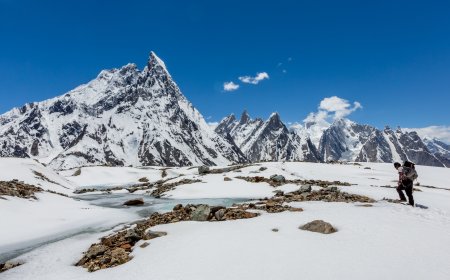
Explore Nun Peak: Ladakh’s 7,135m Giant
Learn about Nun Peak’s height, location, beauty and climbing challenges. A simple guide to one of Ladakh’s most iconic Himalayan summits.
Nun Peak is one of the tallest and most iconic mountains in north-western India. Rising to an altitude of 7,135 meters (23,409 ft), it sits in the Zanskar range of the Indian Himalayas in the Suru Valley of Ladakh. This peak is part of the famous Nun-Kun massif and has long been a magnet for serious climbers from around the world.
Where Nun Peak Is Located
Nun Peak is located in Ladakh, close to the border of Jammu & Kashmir. The massif overlooks the Suru Valley and dominates the skyline on the drive from Leh to Kargil. The twin peaks Nun (7,135 m) and Kun (7,077 m) rise above the valley, forming one of the most striking high-altitude landscapes in the Indian Himalayas.
This region lies in a high cold desert between the Greater Himalayas and the Karakoram Range, where stark rocky terrain meets massive ice fields.
Expedition Overview
A standard Nun Peak expedition takes about 18 to 21 days, starting and ending in Leh. Most itineraries include:
-
Fly into Leh and rest for acclimatization.
-
Travel to Kargil and then to the trailhead at Tangol village.
-
Trek to Nun Base Camp (around 4,500 m), then higher camps.
-
Acclimatize and load carry between camps.
-
Final summit push before returning down to Base Camp and then back to Leh.
The trek portion from Kargil to Nun Base Camp is roughly 8–9 km and takes 5–6 hours. Climbers must navigate rugged, rocky trails, glacial streams and high-altitude moraine before reaching the snow and ice fields of the mountain itself.
Climbing Difficulty
Climbing Nun is considered technical and challenging. Above the base camp, the route involves steep snow and ice, crevassed glaciers and fixed ropes in various sections. Camp positions are typically set at increasing altitudes to allow climbers to acclimatize properly.
The approach to the upper ridge requires using crampons, ice axes and rope techniques. Icy slopes can reach angles up to 50–70 degrees, demanding strength, endurance and good climbing skill.
Weather conditions are unpredictable in the high Himalayas. Clouds, wind and low temperatures can delay summit attempts, and expeditions often build buffer days into the schedule to allow acclimatization and to adapt to unexpected weather changes.
Best Time to Climb
The best time for a Nun Peak expedition is usually July and August, when the weather in the Himalayas is relatively stable and storms are less frequent. Snow conditions are more manageable in these months, and days are longer, which helps climbers maintain a steady pace.
Due to its high elevation, the peak remains cold year-round, and frost and deep snow are common even in the optimal season.
Preparation and Fitness
To succeed on Nun Peak, climbers must prepare physically and mentally. Key preparation includes:
-
Cardiovascular fitness through running, cycling and stair climbing.
-
Strength training for long ascents with gear and backpacks.
-
High-altitude experience through previous treks or climbs above 5,000 m.
-
Technical skills such as rope handling and crevasse rescue techniques.
Acclimatization is critical. Climbers often follow a strategy of climbing high during the day and returning to lower camps at night to help the body adjust to altitude.
Cultural and Scenic Highlights
Before the climb, many expeditions explore the cultural sites around Leh. Places like Shey Palace, Thiksey Monastery and Hemis Monastery offer insight into Ladakh’s Buddhist heritage. The drive through high mountain passes such as Fotu La and Namika La reveals dramatic Himalayan landscapes.
The Suru Valley itself is one of Ladakh’s most beautiful regions, with stark mountains, deep gorges and the glacial tongues of the Nun-Kun massif stretching into the sky.
Safety and Permits
Climbing Nun Peak requires mountaineering permits issued by Indian authorities. Expedition organizers handle most of the paperwork, including permits, guide services and base camp logistics.
Safety equipment such as oxygen cylinders, proper boots, fixed ropes and communication gear is vital. Most expedition groups also carry weather forecasts and emergency plans to respond to adverse conditions.
The journey to the summit of Nun Peak is both physically demanding and rewarding. Its towering height, technical sections, and stunning Himalayan setting make it a bucket-list expedition for climbers seeking a serious challenge in one of India’s most remote and dramatic mountain landscapes.
What's Your Reaction?
 Like
0
Like
0
 Dislike
0
Dislike
0
 Love
0
Love
0
 Funny
0
Funny
0
 Angry
0
Angry
0
 Sad
0
Sad
0
 Wow
0
Wow
0