
SC quashes law denying maternity leave to adoptive

The Supreme Court quashes the law denying maternity leave to adoptive mothers, ensuring they can avail leave irrespective of the adopted child’s exact age.

Mar 17, 2026 - 17:52
Mar 17, 2026 - 18:27
 0  2

1. Supreme Court Grants Equal Maternity Leave Rights to Adoptive Mothers

Supreme Court Grants Equal Maternity Leave Rights to Adoptive Mothers

In a landmark decision, the Supreme Court of India has redefined the rights of working mothers who adopt children. On March 17, 2026, the Court struck down the law that denied maternity leave to adoptive mothers if the child was older than three months, calling it unconstitutional and discriminatory. This ruling ensures that all working mothers whether biological or adoptive receive equal protection and support at work, making India’s workplace policies more inclusive. 

2. Supreme Court’s Verdict on Maternity Leave

The Court reviewed Section 60(4) of the Social Security Code, 2020, which restricted maternity leave for adoptive mothers to cases where the adopted child was less than three months old. The bench held that this age-based restriction violated Articles 14 and 21 of the Constitution, which guarantee equality and personal liberty. The Court emphasised that this arbitrary limitation treated adoptive mothers unfairly, ignoring the core purpose of maternity leave: to ensure time for bonding, care, and recovery.
The Court highlighted that maternity leave is a fundamental right, and the need for maternal care does not depend on whether the child is biologically born or adopted. Adoptive mothers are now entitled to 12 weeks of maternity leave, starting from the date the child is handed over, regardless of the child’s age. This ruling brings adoptive mothers on par with biological mothers, providing them legal certainty and emotional security during a critical phase of child-rearing.

3. What the Old Law Said

Previously, under the Maternity Benefit (Amendment) Act, 2017, and later the Social Security Code, 2020, adoptive mothers were eligible for 12 weeks of maternity leave only if the adopted child was below three months old. While intended to support mothers of infants, this provision ignored the realities of the adoption process, which often involve lengthy legal procedures, background checks, and government approvals. Many adoptive parents, especially those adopting slightly older children, were left without any official maternity support.
Critics argued that this restriction was unfair and arbitrary, creating an unnecessary divide between adoptive mothers whose children were younger than three months and those whose children were older. Moreover, adoption processes governed by the Juvenile Justice (Care and Protection of Children) Act, 2015, often take months, making this arbitrary cut-off particularly restrictive.

4. Why This Ruling is Important

1. Promoting Equality for All Working Mothers

This decision reinforces that every working woman who becomes a mother through childbirth or adoption deserves equal rights and protection. The Court recognised that bonding with a child and caregiving responsibilities are equally critical for adoptive mothers. The ruling eliminates a discriminatory barrier, ensuring adoptive mothers can focus on nurturing their children without workplace anxiety.

2. Recognising Non-Biological Parenthood
By striking down the age-based restriction, the Supreme Court gave legal recognition to non-biological motherhood, acknowledging the legitimacy and importance of adoptive families. The judgment reflects a broader understanding of parenthood in modern society, where families can be built in many ways beyond biological childbirth, including adoption and surrogacy.
3. Encouraging Progressive Workplace Policies
The ruling also highlights maternity leave as an essential social security benefit, not merely a workplace perk. This could pave the way for more inclusive family-friendly policies, including paid paternity leave and flexible work arrangements, ensuring that both parents actively participate in childcare.

5. Evolution of Maternity Leave Laws in India
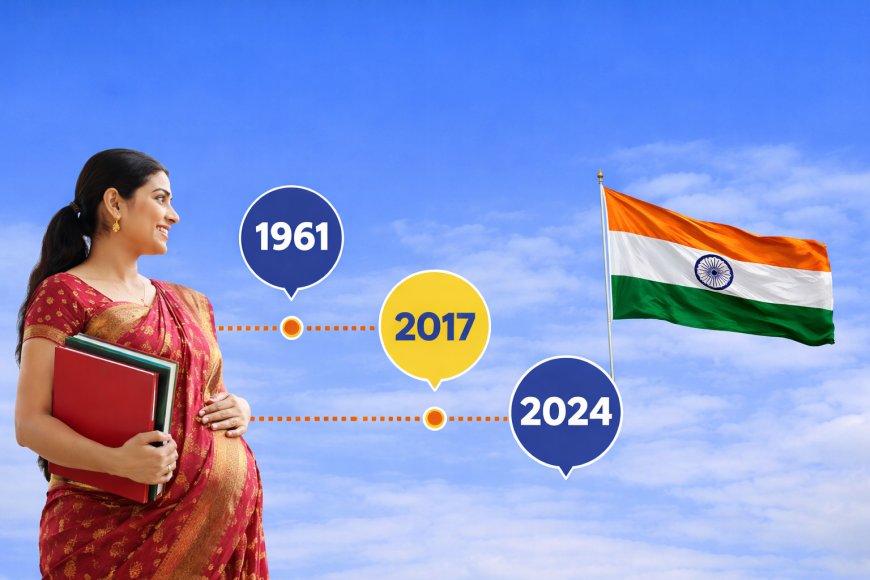
Evolution of Maternity Leave Laws in India
India has gradually strengthened maternity leave protections over the years:
The Maternity Benefit Act, 1961, provided initial leave and financial protection for women employees.
The 2017 amendment extended paid maternity leave for biological mothers from 12 weeks to 26 weeks, while adoptive and commissioning mothers received 12 weeks.
The Social Security Code, 2020, consolidated labour laws but initially maintained the outdated age restriction for adoptive mothers, which was subsequently removed by the Supreme Court.
Courts in India have also extended maternity protections to surrogate mothers and non-traditional family setups, strengthening the principle of equality in workplace benefits. For instance, the Orissa High Court ruled that maternity leave should be granted to mothers via surrogacy, recognising their right to bonding and care time.

6. Impact on Employers and Employees

Impact on Employers and Employees
Following this ruling, employers across India will need to update their maternity leave policies for adoptive mothers. Government agencies and private companies will be required to align workplace policies with the new legal standard. This provides adoptive mothers with job security and confidence in returning to work after maternity leave, knowing their rights are protected.
Furthermore, the Supreme Court’s discussion on paternity leave may lead to future legislation, encouraging shared parenting and supporting fathers in childcare responsibilities. This could reshape workplace culture, making it more equitable and family-oriented.

7. Conclusion

The Supreme Court's decision is a milestone for gender equality and workers’ rights in India. By removing the age restriction, the judgment reinforces that all mothers deserve dignity, support, and time to care for their children, regardless of how they become mothers.
This ruling not only benefits adoptive mothers but also encourages progressive reforms for inclusive family policies in Indian workplaces. With this decision, India moves closer to a society where parental rights are recognised equally, and every child receives the care and attention they deserve from their parents.

What's Your Reaction?

Like Like 0
Dislike Dislike 0
Love Love 0
Funny Funny 0
Angry Angry 0
Sad Sad 0
Wow Wow 0
Harshita Dhakad Now working as a Social Media Marketing Executive at [Shakuniya Solutions Pvt Ltd] Excited to create content that connects, campaigns that convert, and communities that grow. 💻💡 #SocialMediaLife #MarketingJourney”