
Asteroid 2024 YR4 to Pass Safely Near Moon in 2032
NASA confirms Asteroid 2024 YR4 will safely pass near the Moon in 2032 with no threat to Earth. Scientists continue monitoring near-Earth objects.
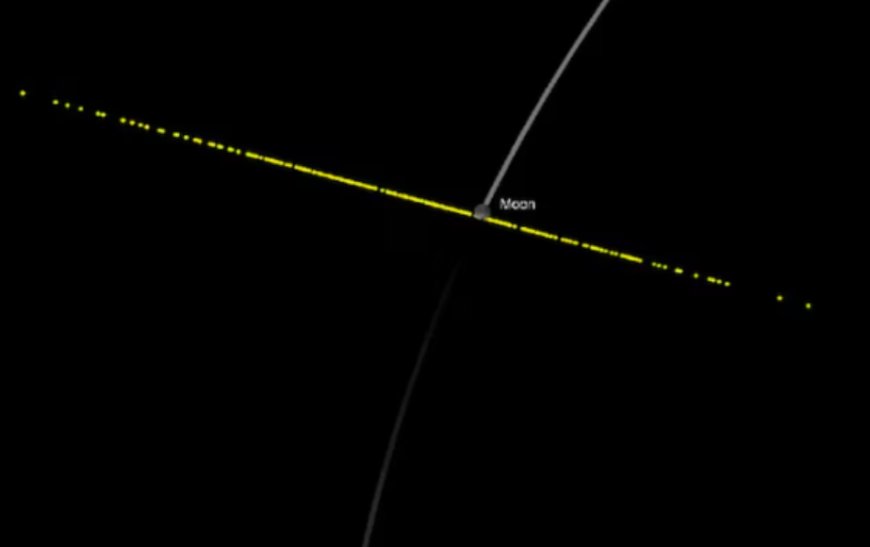
NASA scientists have confirmed that Asteroid 2024 YR4, a recently discovered near-Earth object, will pass safely near the Moon in December 2032. Updated orbital calculations show that the asteroid will not collide with either the Moon or Earth. The new findings come after detailed observations and improved modelling of the asteroid’s path through the solar system.
Early measurements had created some interest among astronomers because the asteroid appeared to have a small probability of approaching the Earth–Moon system closely. As more observations were collected from telescopes and space-based instruments, scientists were able to refine the asteroid’s orbit and remove the possibility of an impact.
Current estimates show that the asteroid will pass the Moon at a distance of roughly 13,200 miles (about 21,200 kilometres), which is considered a safe margin in astronomical terms.
NASA Confirms Asteroid Will Not Strike Earth or the Moon
Researchers working with NASA’s Centre for Near-Earth Object Studies (CNEOS) analysed the asteroid’s trajectory using advanced orbital calculation systems. These systems combine data from telescopes around the world and observations from space missions.
Earlier predictions had suggested that Asteroid 2024 YR4 had a very small chance of striking Earth in 2032. At one stage in 2025, the probability of an Earth impact briefly reached around three per cent, which drew the attention of planetary defence teams.
However, as astronomers continued tracking the asteroid, new data allowed scientists to refine its orbit. By early 2025, researchers had already ruled out any collision with Earth. Later calculations also showed that the asteroid would not collide with the Moon either.
According to scientists, such changes in probability are normal when a new asteroid is first discovered. As additional measurements are collected over time, uncertainties in the orbital path are reduced.
Discovery of Asteroid 2024 YR4
Asteroid 2024 YR4 was first detected on 27 December 2024 during automated sky surveys designed to search for near-Earth objects. These surveys use wide-field telescopes that scan the night sky to identify moving objects that may approach Earth’s orbit.
Once the asteroid was detected, astronomers around the world began collecting follow-up observations. These observations help scientists determine the object’s speed, direction and distance from Earth.
Near-Earth asteroids are objects that orbit the Sun and sometimes pass through the region of space close to Earth’s orbit. Because of this, they are closely monitored by planetary defence programmes.
Size and Characteristics of the Asteroid
Current estimates suggest that Asteroid 2024 YR4 is about 60 metres in diameter, roughly comparable to the height of a 15-storey building.
The asteroid is considered relatively small compared with the large asteroids that shaped the early solar system. However, objects of this size can still cause major regional damage if they were to strike Earth.
Astronomers estimate the size of an asteroid using measurements of its brightness and reflected sunlight. By analysing these observations, scientists can estimate the object’s diameter and surface properties.
Observations from the James Webb Space Telescope also helped scientists better understand the asteroid’s size and composition. Space-based observations provide higher precision measurements than many ground-based telescopes.
Orbital Path and Future Flybys
Asteroid 2024 YR4 follows an orbit around the Sun that occasionally brings it into the region of space near Earth. Scientists calculate its trajectory by repeatedly measuring its position against distant background stars.
The asteroid is expected to make another safe flyby of Earth in 2028 before its closer approach to the Earth–Moon system in 2032. These future observations will allow astronomers to further refine the asteroid’s orbit.
As the asteroid moves farther away from Earth after each observation period, it becomes more difficult to detect with telescopes. Scientists, therefore, collect as much data as possible while the object remains visible.
Planetary Defence and Asteroid Monitoring
NASA and other international space agencies monitor thousands of near-Earth objects every year. The goal is to identify potentially hazardous asteroids long before they could pose a risk.
Planetary defence programmes combine data from telescopes, radar systems and computer simulations to track these objects. Early detection gives scientists time to study their orbits and consider possible mitigation strategies if needed.
The discovery of Asteroid 2024 YR4 was considered one of the most significant asteroid alerts in recent years because its early calculations briefly showed a measurable impact probability.
Events like this help scientists test the effectiveness of global asteroid monitoring systems.
Scientific Value of Close Asteroid Passes
Even though Asteroid 2024 YR4 poses no danger, close flybys provide valuable scientific opportunities. Researchers can use such encounters to study the composition and structure of objects that formed during the early stages of the solar system.
Asteroids contain material that has remained largely unchanged for billions of years. By analysing their surface properties and motion, scientists gain insight into how planets formed and evolved.
Close approaches also allow astronomers to test new observation techniques and improve their orbital prediction models. Each observation helps refine the accuracy of future predictions.
Continued Observation in the Coming Years
Although the asteroid’s path is now well understood, astronomers will continue monitoring Asteroid 2024 YR4 during future observation windows. The next opportunity to study the asteroid closely is expected during its approach in 2028.
Scientists say that constant monitoring of near-Earth objects is essential for long-term planetary safety. Improved telescopes and data analysis tools are helping researchers detect and track more asteroids each year.
For now, NASA confirms that the 2032 passage of Asteroid 2024 YR4 will simply be another routine astronomical event. The asteroid will pass safely near the Moon without posing any threat to Earth or its natural satellite.
What's Your Reaction?
 Like
0
Like
0
 Dislike
0
Dislike
0
 Love
0
Love
0
 Funny
0
Funny
0
 Angry
0
Angry
0
 Sad
0
Sad
0
 Wow
0
Wow
0