


















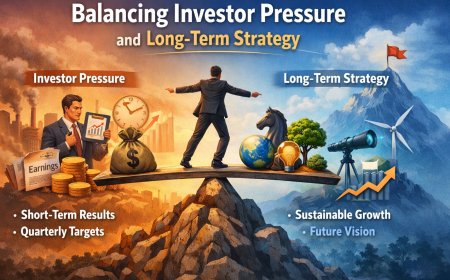




































































































































































































Balancing Investor Pressure and Long-Term Strategy
Discover how Indian companies manage investor expectations while focusing on long-term growth, revealing insights into modern corporate strategy.
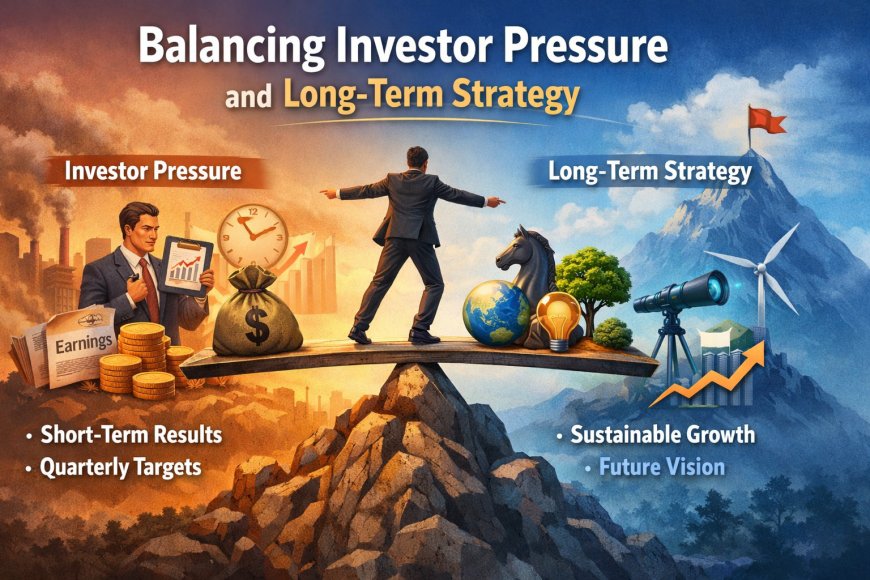
Companies across India and global markets are recalibrating priorities as balancing investor pressure and long-term strategy becomes a defining challenge for executive leadership. Corporate boards face rising demands from shareholders for immediate returns, even as large capital investments in technology, compliance, and expansion require patience to deliver measurable outcomes.
Recent reporting by Economic Times and Reuters shows that listed firms increasingly align operational messaging around profitability timelines, capital allocation discipline, and forward guidance clarity. Executives now face closer scrutiny not only on quarterly earnings but also on strategic spending commitments extending over three to five years.
Investor Expectations Intensify Amid Slower Global Growth
Balancing investor pressure and long-term strategy has become more complex since early 2023, when global economic growth slowed to 3.0%, according to estimates cited by the Financial Times. Rising interest rates in the United States, Europe, and emerging markets shifted investor focus toward cash generation and margin stability rather than expansion alone.
Public market investors have shown lower tolerance for prolonged losses. Technology companies, which previously benefited from growth-first valuations, faced corrections as institutional investors demanded profitability timelines. According to an analysis published by Bloomberg, companies that demonstrated operating margin improvement of at least 200 basis points between 2023 and 2024 saw stronger stock performance relative to sector peers.
This shift has compelled executives to justify research spending, hiring plans, and infrastructure investments with clearer financial projections. Quarterly earnings calls increasingly include detailed explanations of capital discipline measures, signalling how balancing investor pressure and long-term strategy is influencing corporate messaging.
Indian Firms Adjust Capital Allocation to Maintain Investor Confidence
Indian listed firms have taken visible steps to balance investor pressure and long-term strategy without undermining growth potential. IT major Infosys revised its revenue growth guidance in October 2023 to between 1.0% and 2.5%, down from earlier projections above 4%, reflecting weaker global technology spending. The company simultaneously emphasised operating margin protection within the 20% to 22% band.
Executives indicated that margin preservation remained critical to maintaining shareholder confidence during uncertain demand cycles. Reporting from Business Standard noted that institutional investors increasingly favour predictable earnings over aggressive expansion in volatile environments.
India’s fintech sector has also experienced regulatory-driven recalibration. In January 2024, the Reserve Bank of India imposed operational restrictions on Paytm Payments Bank due to compliance concerns. The development triggered a sharp market reaction, with the company’s shares falling more than 40% within weeks. Corporate leadership subsequently announced cost optimisation measures and renewed focus on sustainable profitability to restore investor trust.
These developments illustrate how balancing investor pressure and long-term strategy requires flexibility, particularly in regulated industries where compliance investment directly affects financial performance.
Cost Discipline and Workforce Adjustments Reflect Strategic Realignment
Balancing investor pressure and long-term strategy has also influenced workforce decisions. Technology firms worldwide initiated restructuring programs between 2023 and 2025 to reduce operating costs and improve financial efficiency.
Meta Platforms reduced its global workforce by over 20,000 employees across multiple rounds beginning in November 2022 and continuing into 2023, according to disclosures covered by CNBC. Chief Executive Mark Zuckerberg described 2023 as a “year of efficiency,” emphasising cost discipline while maintaining investments in artificial intelligence infrastructure.
Similarly, Microsoft announced workforce reductions affecting approximately 10,000 employees in early 2023, even as it committed billions of dollars to AI development partnerships and cloud expansion. The company’s capital expenditure exceeded $50 billion in fiscal year 2024, highlighting how firms continue investing in strategic areas despite investor scrutiny.
Executives increasingly frame layoffs and restructuring as necessary steps to strengthen long-term competitiveness rather than purely reactive measures. This positioning helps maintain investor confidence while preserving strategic investment capacity.
Regulatory and Governance Pressures Reinforce Long-Term Accountability
Balancing investor pressure and long-term strategy is also shaped by regulatory expectations and governance standards. Market regulators in India and other major economies have tightened disclosure requirements, compelling companies to provide clearer information about financial risks and capital deployment.
The Securities and Exchange Board of India introduced enhanced disclosure norms in 2023, requiring listed entities to report material events, financial exposures, and board decisions within stricter timelines. According to reporting by LiveMint, these reforms aim to improve transparency and protect minority investors.
Corporate boards have responded by strengthening independent oversight and risk management processes. Institutional investors increasingly engage directly with company management on strategic direction, capital allocation, and governance standards. Proxy advisory firms now play a more influential role in evaluating executive compensation, especially when performance metrics diverge from shareholder expectations.
Such oversight reinforces accountability while encouraging companies to align short-term performance with sustainable growth objectives.
Market Valuations Reflect Confidence in Strategic Execution
Balancing investor pressure and long-term strategy has direct implications for market valuation and capital access. Companies that demonstrate consistent execution and clear strategic vision have maintained stronger equity valuations despite broader market volatility.
According to analysis reported by The Hindu and The Indian Express, firms that achieved positive free cash flow growth exceeding 15% year-on-year during 2024 attracted increased institutional investment inflows. Stable cash generation assures that companies can sustain operations and invest in innovation without relying heavily on external financing.
Investor communication has emerged as a critical factor in valuation stability. Companies now provide detailed earnings guidance, long-term financial targets, and capital allocation frameworks. These disclosures help investors evaluate how balancing investor pressure and long-term strategy supports both immediate returns and future expansion.
Companies that fail to communicate strategic direction effectively often face share price volatility and reduced investor confidence.
Leadership Messaging Signals Continued Strategic Discipline
Senior executives across sectors have emphasised disciplined capital allocation while preserving strategic investment priorities. Leadership statements increasingly highlight multi-year investment cycles, particularly in digital infrastructure, artificial intelligence, and sustainability initiatives.
Corporate earnings calls throughout 2024 and 2025 show consistent emphasis on return on invested capital, operating margin expansion, and disciplined spending. Investors continue to reward firms that deliver measurable financial progress alongside credible long-term planning.
Balancing investor pressure and long-term strategy now defines how companies approach hiring, expansion, and innovation decisions. Strategic execution, transparency, and financial discipline remain key factors influencing investor confidence and market performance.
What's Your Reaction?
 Like
0
Like
0
 Dislike
0
Dislike
0
 Love
0
Love
0
 Funny
0
Funny
0
 Angry
0
Angry
0
 Sad
0
Sad
0
 Wow
0
Wow
0