India attended the first Board of Peace meeting on Gaza as an observer, balancing ties with the US, Israel and Arab nations while preserving strategic autonomy.
India’s decision to attend the first meeting of the newly formed Board of Peace on Gaza as an observer, rather than a full member, reflects a carefully balanced diplomatic approach. While the forum was launched in Washington with significant financial pledges and strong political messaging, New Delhi chose to participate without formally committing itself to the initiative.
The move signals engagement without entanglement.
What Is the Board of Peace?
The Board of Peace on Gaza is a new initiative introduced by US President Donald Trump to oversee the post-war phase in Gaza. Its stated objectives include:
Preserving the ceasefire
Coordinating reconstruction funding
Managing long-term stabilisation efforts
Potentially serving as a broader mediation platform in future conflicts.
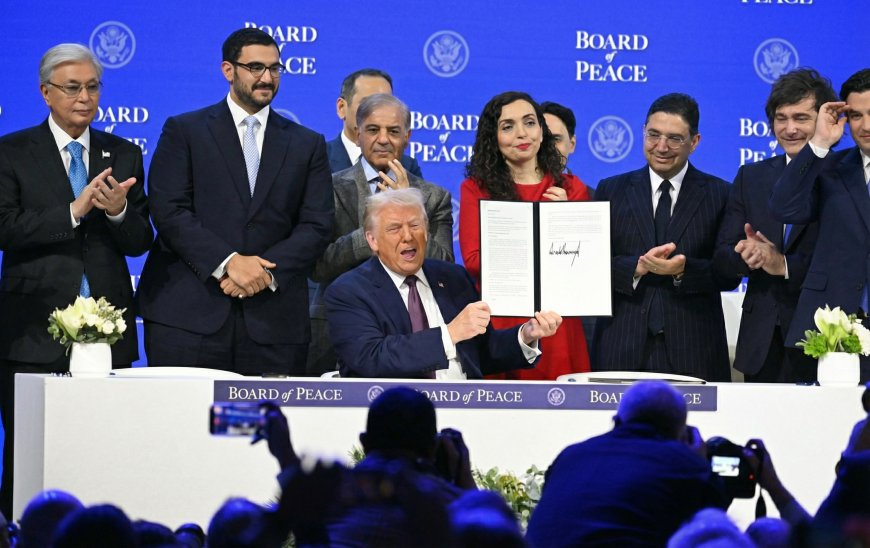
At its inaugural meeting in Washington, representatives from nearly 50 countries attended, including Israel, Saudi Arabia, Qatar, the UAE, Pakistan and several others. The United States announced a proposed $10 billion contribution toward Gaza’s rebuilding, while additional pledges from other countries were said to bring early commitments close to $17 billion. However, much of this funding remains subject to formal approvals and operational clarity.
Discussions also touched on the possibility of an International Stabilisation Force, potentially made up of troops from Muslim-majority countries, to secure reconstruction efforts if Gaza transitions into a demilitarised phase.
Despite the scale of the announcements, many operational details remain undefined.
Why India Chose Observer Status
India was represented by its Chargé d’Affaires in Washington, a diplomatic choice that conveyed seriousness without elevating the engagement to ministerial level. The decision to attend as an observer reflects multiple strategic considerations.
Protecting Strategic Autonomy
India maintains strong relationships across West Asia. It has deep defence and technology ties with Israel, significant energy and diaspora links with Gulf nations, and growing engagement with other regional players. Joining the Board as a founding member could have tied India to every decision taken by the body. Observer status allows India to remain informed without being bound.
Engaging the United States Carefully
While maintaining close ties with Washington, India avoided formally endorsing an institution whose long-term structure and funding mechanisms are still evolving. The United States’ financial pledge has yet to pass through congressional processes, and the governance model of the Board remains under development.
Maintaining Global South Credibility
India positions itself as a voice of the Global South. Moving too quickly into a US-designed framework could have raised concerns among developing nations and parts of the Muslim world. By observing rather than joining, India signals openness to peace efforts while retaining independent judgment.
What Happened at the First Meeting
Reports suggest that the discussions centred on three areas: financial commitments, security arrangements and political messaging.
The United States reiterated its $10 billion pledge for reconstruction, while Gulf countries discussed additional contributions. The idea of a stabilisation force to support demilitarisation and reconstruction was also explored. However, no binding operational framework was finalised.
India did not announce financial commitments or take a prominent speaking role. Its participation was largely focused on listening, assessing the tone of the forum and evaluating its future direction.
Implications for India’s Foreign Policy
India’s choice reflects a broader diplomatic pattern often described as multi-alignment. Rather than remaining outside major initiatives, New Delhi engages selectively, joining some platforms fully, observing others closely and declining those that do not align with its interests.
In this case, India has kept its options open. If the Board of Peace becomes widely supported and institutionally credible, India retains the flexibility to deepen its role. If it struggles with legitimacy or implementation, New Delhi avoids being tied to an ineffective mechanism.
This approach also aligns with India’s long-standing position on the Israel-Palestine issue: support for a two-state solution, humanitarian assistance for Palestinians, and strong bilateral ties with Israel.
What Comes Next
Several factors will determine the Board’s future relevance:
Whether US funding receives full legislative backing
Whether the ceasefire in Gaza remains stable
The extent of meaningful engagement by Arab and Muslim-majority countries
Clarity around governance and reconstruction oversight
India will likely monitor each of these developments closely.
A Calculated Presence
India’s attendance at the Board of Peace as an observer represents a calibrated diplomatic choice. It demonstrates willingness to engage in reconstruction discussions while preserving strategic flexibility. In a region marked by shifting alliances and sensitive political dynamics, New Delhi has chosen to remain visible without becoming vulnerable.
The coming months will reveal whether the Board evolves into a durable platform for stability. Until then, India’s position allows it to watch carefully and decide its next steps on its own terms.
JAHID
I am a writer who focuses on business insights and real-life stories, with an emphasis on real-time relevance rather than traditional reporting. My work explores market behavior, business realities, and human experiences through research, observation, and analysis. Instead of news reporting, I write explanatory and narrative-driven articles that connect business trends with real-world impact. My goal is to present meaningful, accurate, and relatable stories that help readers understand both markets and life beyond the headlines.
Which economic trend will impact businesses most in 2026?
Total Vote: 10
Inflation & currency shifts
20 %
AI adoption in core operations
50 %
Supply chain disruptions
20 %
Rising customer acquisition costs
10 %
Do you believe AI will replace human jobs or support them?
Total Vote: 8
Replace many jobs
37.5 %
Support humans and increase productivity
12.5 %
Create new job roles
50 %
Still unsure
0 %
“What is the single biggest reason software startups fail?”
Total Vote: 9
Poor market fit
11.1 %
Lack of funding or cash flow issues
55.6 %
Weak team or execution
22.2 %
Strong competition
11.1 %
Which factor most directly determines long-term scalability of a digital platform?
Total Vote: 7
A) Initial funding
14.3 %
B) Number of users at launch
14.3 %
C) System architecture and automation
42.9 %
D) Marketing spend
28.6 %
What’s your primary goal for using PrimeSynapse this month?
Total Vote: 4
Expanding my professional network
0 %
Streamlining my daily workflow
0 %
Analyzing performance data
75 %
Exploring new platform features
25 %
What type of content should PrimeSynapse focus on more?
Total Vote: 6
Practical tech insights
16.7 %
Thought-provoking perspectives
50 %
AI & future technology
33.3 %
Digital well-being & productivity
0 %
Which article format do you prefer?
Total Vote: 7
How-to guides
0 %
Opinion pieces
28.6 %
Listicles
71.4 %
This website uses cookies to enhance your browsing experience. By continuing to use this site, you consent to the use of cookies. Please review our Privacy Policy for more information on how we handle your data.

 Like
1
Like
1
 Dislike
0
Dislike
0
 Love
0
Love
0
 Funny
0
Funny
0
 Angry
0
Angry
0
 Sad
0
Sad
0
 Wow
0
Wow
0