Government Prioritises Domestic PNG and CNG Supply Under New Gas Regulation Order
Government prioritises domestic PNG and transport CNG under the Natural Gas Supply Regulation Order 2026 amid global gas supply disruptions.
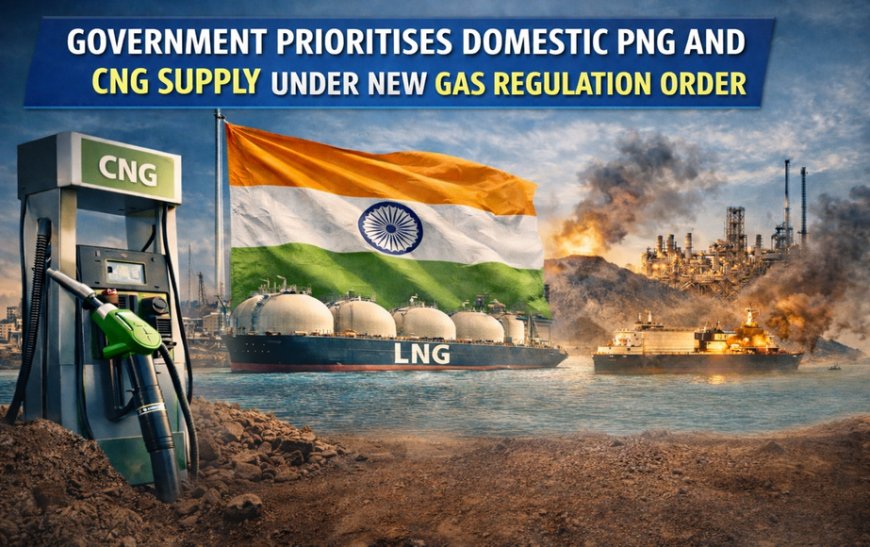
The Government of India has issued a regulatory order prioritising domestic piped natural gas (PNG) and compressed natural gas (CNG) for transportation. This aims to ensure fuel availability amid global gas market disruptions. The directive, under the Natural Gas (Supply Regulation) Order, 2026, follows suppliers curtailing gas deliveries due to geopolitical tensions in the Middle East.
The development was disclosed through a regulatory filing by Adani Total Gas Limited, which stated that the government order prioritises domestic PNG consumers and CNG transport users at the top of the allocation list. The move is intended to maintain an uninterrupted energy supply for households and public transport systems even as international supply chains face uncertainty.
Supply Curtailments Trigger Government Intervention
The government’s intervention follows supply reductions by certain natural gas providers amid instability in global energy markets. Liquefied natural gas (LNG) shipments have been particularly affected due to tensions in the Middle East, a region that plays a central role in global energy exports.
Energy shipments through the Strait of Hormuz, a key maritime route for oil and gas trade, have faced recent disruptions. According to the company’s regulatory disclosure, some suppliers invoked force majeure. This is a contractual provision used when unforeseen circumstances prevent the fulfilment of supply commitments.
These supply adjustments have affected multiple companies involved in city gas distribution. In the case of Adani Total Gas, the curtailments primarily impacted industrial customers connected to its gas distribution network.
To address the situation and stabilise supply availability, the government invoked provisions under the Essential Commodities Act, 1955, which allows authorities to regulate the production, supply, and distribution of essential fuels during periods of disruption.
Priority Allocation for Household PNG and Transport CNG
The Natural Gas (Supply Regulation) Order, 2026, introduces a structured allocation system that places certain sectors at the top of the gas distribution hierarchy.
Under the directive, domestic PNG supply for households and CNG used in the transport sector will receive the highest priority. These segments will be eligible to receive up to 100 per cent of their average gas consumption over the previous six months, depending on operational availability.
The policy aims to ensure that residential cooking fuel supply and urban transport services continue to operate without disruption, even if international gas supplies fluctuate.
Along with PNG and CNG consumers, the government has also prioritised other operational requirements that are essential for maintaining the gas distribution ecosystem. These include LPG production facilities and pipeline compressor fuel, both of which are necessary for sustaining the functioning of gas transmission networks across the country.
By securing supply for these sectors first, authorities aim to minimise the impact of global supply constraints on essential services.
Reduced Allocation for Fertiliser and Industrial Consumers
While priority sectors are eligible for full allocation based on past consumption, the government order introduces controlled supply levels for other industries.
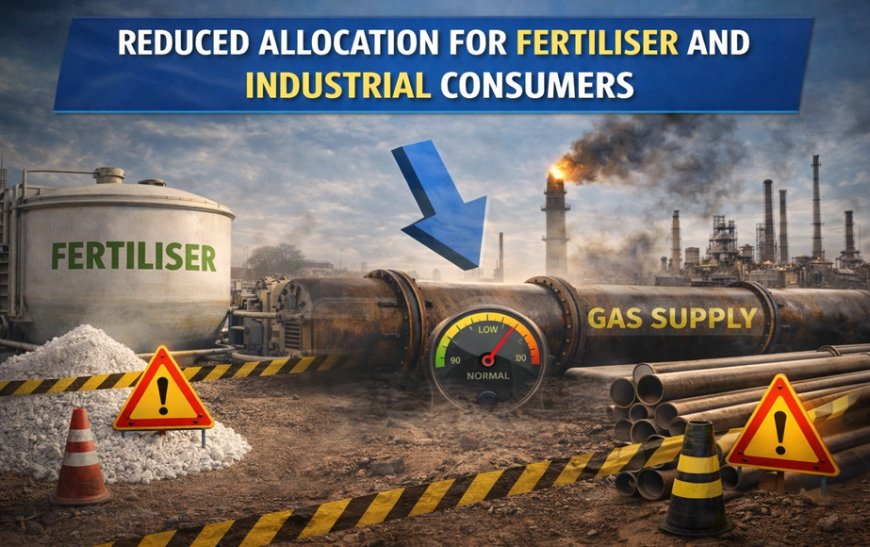
According to the regulatory framework, fertiliser plants will receive approximately 70 per cent of their average gas consumption over the past six months. This reduced allocation reflects the need to balance available supplies across multiple sectors.
Other industries will receive a slightly higher share of supply. Tea industries, manufacturing units, and other industrial consumers are expected to receive around 80 per cent of their previous six-month average gas consumption, subject to availability.
City gas distribution companies have been directed to manage allocations accordingly. Industrial and commercial customers connected to these networks will receive gas supplies aligned with the revised distribution structure.
The order applies broadly across the natural gas supply chain, covering domestic gas producers, LNG importers, pipeline operators, and city gas distribution companies operating in India’s energy sector.
Additional Measures to Support Domestic Fuel Availability
Alongside the gas allocation framework, the government has introduced additional steps aimed at strengthening domestic fuel availability.
Refineries have been instructed to maximise liquefied petroleum gas (LPG) production for domestic use. This may involve diverting certain hydrocarbon streams into the LPG pool to increase the supply of cooking fuel available to households.
These measures are designed to provide a buffer against prolonged global supply disruptions. By ensuring that critical fuels remain available domestically, policymakers aim to reduce the risk of shortages affecting households and essential services.
The order also indicates that further adjustments may be implemented if international supply disruptions intensify. In such situations, gas allocations to petrochemical facilities and power generation plants could be curtailed in order to maintain supply for higher-priority sectors.
Company Response to the Government Directive
Adani Total Gas acknowledged the government’s decision and welcomed the prioritisation framework. In its regulatory filing, the company stated that it appreciates the prompt action taken by authorities to address supply challenges affecting the natural gas sector.
“The company appreciates the Government’s prompt efforts in bringing out the said Order and according priority for the gas supplies to Domestic PNG and CNG customers, as well as supply of PNG to Industrial and Commercial Customers,” the company said in the filing.
The company added that it is currently reviewing the operational implications of the revised allocation framework and supply curtailments. It is also coordinating with authorities and suppliers to manage the impact of reduced gas deliveries.
Market Reaction and Stock Movement
Shares of Adani Total Gas recorded a strong upward movement during the trading session following the development. The company’s stock was trading at ₹561.40, reflecting a gain of 18.35 per cent on the Bombay Stock Exchange (BSE) at around 1:34 PM.
The price movement came as investors reacted to the government’s intervention aimed at maintaining supply stability in the city gas distribution sector.
Policy Response to Global Energy Uncertainty
The Natural Gas (Supply Regulation) Order, 2026, represents a policy measure designed to manage domestic fuel availability during periods of global supply instability. With international energy routes experiencing disruptions and suppliers adjusting deliveries, the government’s prioritisation framework seeks to maintain balance within the country’s gas distribution system.
By ensuring uninterrupted supply for household PNG consumers and transport CNG users, authorities aim to safeguard essential services while managing limited resources across multiple industrial sectors.
What's Your Reaction?
 Like
0
Like
0
 Dislike
0
Dislike
0
 Love
0
Love
0
 Funny
0
Funny
0
 Angry
0
Angry
0
 Sad
0
Sad
0
 Wow
0
Wow
0

Kulshreshth Chaturvedi
I’m Kulshreshth Chaturvedi, a writer and author specialising in creative writing, blogs, and professional content. I write on literature, ideas, and modern perspectives, focusing on clear, engaging, and well-structured storytelling. My goal is to create meaningful writing that inspires readers, builds connections, and delivers real value through words.