Asian stocks rally: Nikkei +1600, KOSPI jumps, oil
Asian stocks rally as Nikkei 225 surges 1600 points and KOSPI jumps, helped by easing oil prices and rising investor confidence across regional markets today.
The Asian stock market today showed a strong recovery after a period of volatility earlier in the week. Major Asian indices rebounded sharply as oil prices eased, bringing relief to investors who had been worried about rising energy costs and global economic uncertainty. Markets across Japan and South Korea led the rally, underscoring the close connection between regional stock markets and global oil prices and geopolitical developments.
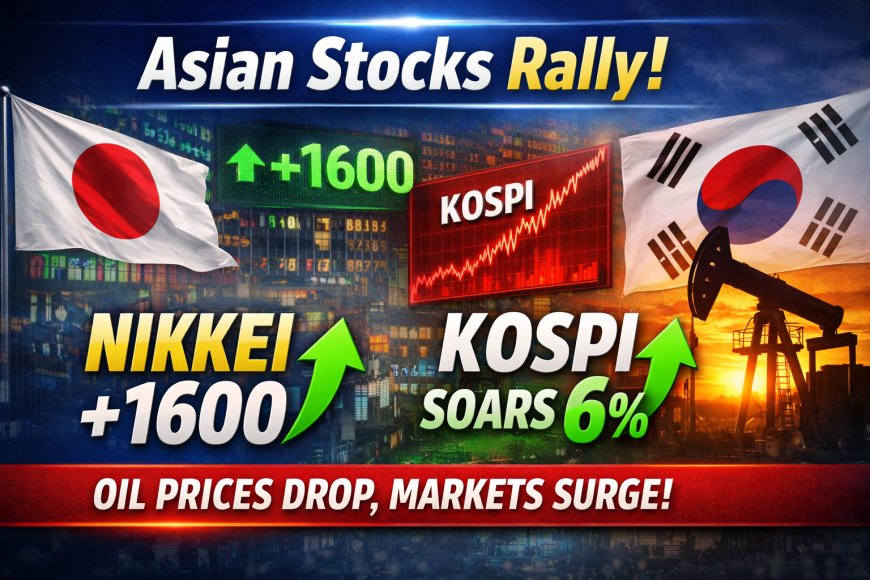
On Tuesday, South Korea’s KOSPI index surged by nearly 6 per cent, marking one of its strongest single-day gains in recent months. At the same time, Japan’s Nikkei 225 jumped by more than 1,600 points, reflecting renewed investor confidence after a sharp sell-off earlier. The recovery followed a decline in crude oil prices after they had reached their recent highs, which had earlier triggered panic selling across global markets.
Financial analysts say the movement in the Asian stock market today clearly shows how sensitive equity markets are to energy price fluctuations and geopolitical tensions.
Asian Stock Market Today: Oil Prices Bring Market Relief
One of the biggest reasons behind the rally in the Asian stock market today is the cooling of global oil prices. Earlier, crude oil prices had surged close to 120 dollars per barrel, raising fears of inflation and economic slowdown in several countries. However, prices later dropped to around 90 to 92 dollars per barrel, easing pressure on financial markets.
For many Asian economies, energy imports are essential for industrial production and transportation. Countries such as Japan and South Korea depend heavily on imported oil, so any increase in prices directly impacts manufacturing costs, airline operations, and logistics. When oil prices rise sharply, companies often face higher expenses, which can reduce profit margins and weaken investor sentiment.
The recent drop in crude prices, therefore, played a crucial role in stabilising the Asian stock market today. Investors viewed the decline as a sign that global energy supply may not face immediate disruptions, allowing markets to recover.
Nikkei and Kospi Lead the Regional Rally
Japan and South Korea were the biggest contributors to the surge in the Asian stock market today. Japan’s Nikkei 225, one of the most important stock indices in Asia, gained more than 3 per cent during the trading session. Technology and manufacturing companies led the rise as investors returned to the market following the earlier downturn.
Similarly, South Korea’s KOSPI recorded a strong jump of around 6 per cent. The index tracks the performance of some of the country’s largest corporations, including companies in electronics, automobiles, and technology sectors.
South Korea’s market is heavily influenced by the semiconductor industry, which plays a major role in the global technology supply chain. When global demand for electronics improves or economic uncertainty declines, technology stocks in the region often see strong buying activity. This trend contributed significantly to the rebound seen in the Asian stock market today.
Geopolitical Tensions and Market Volatility
Despite the recovery, geopolitical tensions remain an important factor affecting the Asian stock market today. Earlier in the week, rising tensions in the Middle East pushed oil prices sharply higher, triggering a wave of selling across global financial markets.
During that period, Japan’s Nikkei 225 had fallen more than 6 per cent, while South Korea’s Kospi also recorded heavy losses. Investors were concerned that any disruption in global oil supply could increase inflation and slow down economic growth.
Another major concern was the security of key shipping routes used for transporting oil. The Strait of Hormuz, for example, is one of the world’s most important energy routes, carrying nearly 20 per cent of global oil supply. Any disruption in this region can immediately impact oil prices and global financial markets.
Because many Asian countries rely heavily on imported energy, geopolitical developments often have a direct effect on the performance of the Asian stock market today.
Global Economic Factors Influencing Markets
Several global economic indicators are also shaping the direction of the Asian stock market today. Investors are closely monitoring a range of factors that can influence market sentiment and future economic growth.
One important factor is interest rate expectations. Decisions made by major central banks, especially the US Federal Reserve, often impact global capital flows. Higher interest rates tend to reduce investment in equities as borrowing costs increase.
Another key factor is the outlook for global trade. Many Asian economies depend heavily on exports, particularly in industries such as electronics, automobiles, and machinery. If global demand weakens, companies in these sectors may face slower growth.
Currency movements also play a role. Changes in exchange rates can influence export competitiveness and corporate profits. For example, a weaker domestic currency can help exporters by making their products cheaper in international markets.
All these elements together influence investor behaviour and determine the performance of the Asian stock market today.
Future Outlook for Asian Markets
Despite recent volatility, many analysts remain optimistic about the long-term outlook of the Asian stock market today. The region continues to experience strong industrial development, technological innovation, and expanding consumer demand.
Japan’s stock market, for instance, has been benefiting from corporate reforms and improved investor participation. Earlier in 2026, the Nikkei 225 reached record highs, reflecting strong corporate earnings and positive economic sentiment.
South Korea and other Asian economies are also gaining global recognition due to advancements in semiconductor technology, electric vehicles, and artificial intelligence. These industries are expected to drive long-term growth in the region.
However, experts also caution that markets may continue to experience short-term fluctuations due to geopolitical tensions, energy price volatility, and global economic uncertainty.
Conclusion
The Asian stock market today highlights how quickly global markets react to changes in oil prices and geopolitical developments. After experiencing sharp declines earlier due to rising crude oil prices, major Asian indices such as the Nikkei 225 and KOSPI managed to recover strongly once energy prices began to stabilise.
Although challenges remain, including geopolitical risks and economic uncertainty, the strong fundamentals of Asian economies continue to support long-term growth. As a result, the Asian stock market today remains an important indicator for global investors watching economic trends in the region.
What's Your Reaction?
 Like
0
Like
0
 Dislike
0
Dislike
0
 Love
0
Love
0
 Funny
0
Funny
0
 Angry
0
Angry
0
 Sad
0
Sad
0
 Wow
0
Wow
0

Harshita Dhakad
Now working as a Social Media Marketing Executive at [Shakuniya Solutions Pvt Ltd]
Excited to create content that connects, campaigns that convert, and communities that grow. 💻💡 #SocialMediaLife #MarketingJourney”