March 10, 2026 |
Dixon Technologies Receives Key Government Approval
In an important development for India’s electronics manufacturing sector, Dixon Technologies (India) Ltd has received regulatory approval from the Ministry of Electronics and Information Technology (MeitY) for its joint venture with HKC Overseas Limited.
Following the announcement, Dixon’s shares rose nearly 5% during intraday trading, touching ₹10,530 before closing around ₹10,286, compared to the previous close of ₹9,804.
The approval was granted under Press Note 3, a rule that requires government permission for investments coming from countries sharing land borders with India, including China. With this clearance, Dixon can now move forward with its display manufacturing partnership.
Structure of the Dixon–HKC Joint Venture
The joint venture will operate under the name Dixon Display Technologies Private Limited (DDTPL).
Ownership Structure
The project is valued at approximately ₹370 crore (about $42 million).
Investment Contribution
The partnership was first announced in August 2025, and its focus will be the manufacturing of LCD and TFT-LCD display modules used in:
Why This Approval Matters
Press Note 3, introduced in 2020, requires government scrutiny of investments originating from neighboring countries to protect strategic sectors.
Since HKC Overseas is linked to China’s HKC Corporation, the proposal required detailed regulatory review. After several months of evaluation, MeitY granted the approval on March 9, allowing the project to proceed.
However, the joint venture will formally begin operations after completing several procedural steps, including:
Reducing India’s Dependence on Imported Display Panels
India currently imports over 90% of its display panels, primarily from China, South Korea, and Taiwan.
These imports cost the country approximately $10–12 billion annually.
By setting up domestic display module production, the Dixon-HKC partnership aims to:
-
Strengthen India’s electronics supply chain
-
Reduce dependency on imports
-
Support the government’s production-linked incentive (PLI) programs
Industry estimates suggest that local manufacturing could reduce imports by 20–30% within the next 3–5 years.
Technology Advantage: HKC’s Expertise Meets Dixon’s Manufacturing Scale
HKC Corporation, established in 1980, is a global display manufacturer with strong capabilities in LCD technology.
The company contributes:
-
Advanced display manufacturing technology
-
High-yield production systems
-
Experience in large-scale panel manufacturing
HKC is also known for its Gen-8.6 production lines, which are widely used for modern LCD panel manufacturing.
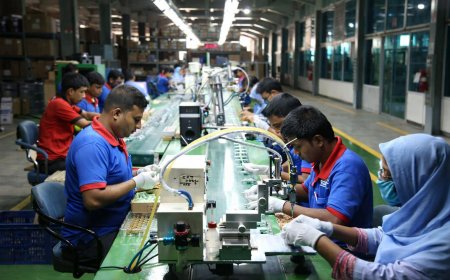
Meanwhile, Dixon Technologies brings extensive manufacturing infrastructure, with more than 10 production facilities across India, including Noida, Chennai, and Tirupati.
Dixon currently manufactures products for leading brands such as:
The combination of global technology and local production capacity creates a strong foundation for the joint venture.
Production Plans and Expansion Targets
The new facility will manufacture TFT-LCD modules, which involve:
-
Depositing thin-film transistors on glass substrates
-
Creating micro-scale electronic circuits
-
Integrating backlights and touch interfaces
The joint venture plans a phased scale-up.
Initial Production Capacity
Future Target
The primary focus will be the Indian market, followed by exports to ASEAN countries.
Opportunities in Automotive and Consumer Electronics
Beyond smartphones and televisions, display demand is growing rapidly in the automotive sector.
Modern vehicles require display panels for:
-
Digital dashboards
-
Infotainment systems
-
Navigation displays
The partnership also plans to explore mini-LED backlight technology, which is becoming increasingly important for high-end televisions and premium display devices.
Local production could significantly reduce supply delays.
Currently, imported panels often take up to 12 weeks to arrive, while domestic manufacturing could reduce delivery timelines to 2–4 weeks.
Stock Market Response
Investors reacted positively to the announcement.
Dixon’s market capitalization crossed ₹62,500 crore, reflecting strong investor confidence in the company’s expansion strategy.
The company reported FY25 revenue of ₹17,692 crore, marking a 45% year-on-year increase, driven by growth in mobile phone and LED manufacturing.
Other electronics manufacturing companies also saw gains:
This movement suggests broader optimism in India’s electronics manufacturing services (EMS) sector.
Potential Impact on Regional Industry
The project could create opportunities for local suppliers and MSMEs in areas such as:
States like Rajasthan are actively promoting electronics manufacturing through incentive programs and infrastructure support.
If supply chains expand in North India, regional industries could benefit from new vendor opportunities and job creation.
Challenges the Project Must Overcome
Despite strong potential, the joint venture will face several operational challenges.
Key issues include:
-
Maintaining high production yield rates (typically 85–90% globally)
-
Ensuring stable power and infrastructure support
-
Building a skilled workforce of 500+ specialized engineers
Geopolitical factors could also influence technology transfer and regulatory requirements in the future.
A Strategic Step for India’s Electronics Industry
The Dixon-HKC partnership marks a significant shift for the company.
Dixon is gradually moving beyond contract manufacturing toward component-level production, a step that can significantly improve margins and long-term competitiveness.
The company aims to generate around $1 billion in display-related revenue by FY2030.
For India’s electronics industry, initiatives like this represent an important step toward building a self-reliant and globally competitive manufacturing ecosystem.





















































































































































































 Like
0
Like
0
 Dislike
0
Dislike
0
 Love
0
Love
0
 Funny
0
Funny
0
 Angry
0
Angry
0
 Sad
0
Sad
0
 Wow
0
Wow
0