























































































































































Pulwama Attack Anniversary: PM Modi Pays Tribute
Prime Minister Narendra Modi pays tribute to 40 CRPF personnel killed in the 2019 Pulwama attack, marking the anniversary with remembrance ceremonies.
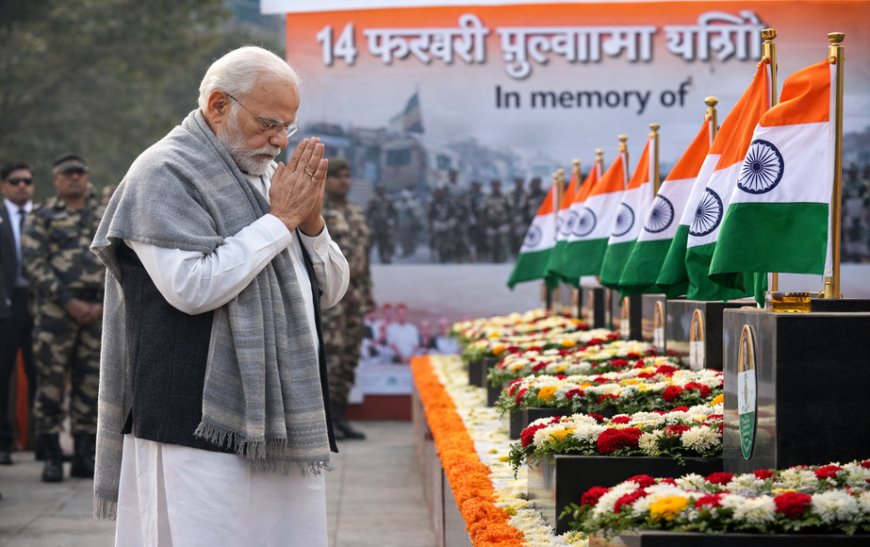
New Delhi: Prime Minister Narendra Modi on 14 February paid tribute to the 40 Central Reserve Police Force (CRPF) personnel who were killed in the 2019 suicide bombing in Pulwama, Jammu and Kashmir. Marking the anniversary of the attack, he said the nation continues to honour their service and sacrifice.
The bombing took place on 14 February 2019 along the Jammu–Srinagar National Highway near Lethpora in Pulwama district. A suicide attacker drove an explosives-laden vehicle into a convoy carrying CRPF personnel. The explosion destroyed one of the buses and damaged several others travelling in the convoy. Forty personnel were killed and many others injured in what remains one of the deadliest attacks on Indian security forces in the region.
At the time, the convoy consisted of more than 78 vehicles transporting over 2,500 personnel who were returning to duty after leave. The scale of the movement and the intensity of the blast led to immediate nationwide reaction. Political leaders across parties condemned the attack, and candlelight marches were organised in several cities.
The remains of the personnel were flown to their respective home states, where funeral processions were attended by large crowds. Images of flag-draped coffins and guard-of-honour ceremonies were widely broadcast, reinforcing the emotional impact of the incident across the country.
Military and Diplomatic Aftermath
Twelve days after the bombing, on 26 February 2019, the Indian Air Force carried out air strikes targeting what the government described as a terrorist training facility in Balakot, Pakistan. The operation marked a significant development in cross-border engagement, with Indian aircraft crossing the Line of Control in a publicly acknowledged action.
Pakistan responded the following day with aerial operations, resulting in an air engagement between the two sides. An Indian Air Force pilot was captured and later released, helping to de-escalate immediate tensions, although military alertness remained high for weeks.
The developments brought India and Pakistan to a period of heightened diplomatic strain. International calls for restraint followed as both countries managed the aftermath of the escalation.
Security Review and Procedural Changes
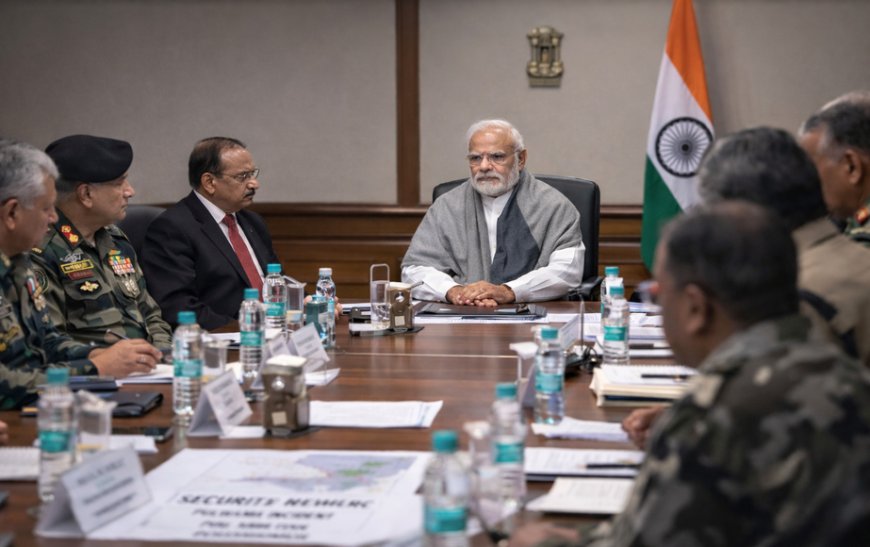
Following the attack, authorities reviewed convoy movement protocols in Jammu and Kashmir. The movement of large security convoys along vulnerable highway stretches was reassessed. In some cases, staggered travel and increased use of air transport were introduced to reduce exposure.
Surveillance and road-opening procedures were strengthened along the Jammu–Srinagar highway. Agencies also intensified intelligence coordination to address vulnerabilities exposed by the incident.
The National Investigation Agency led the probe into the bombing, examining logistical support networks and the sourcing of explosives. Over time, several arrests were made in connection with the case, according to official statements.
The attack also influenced broader security discussions in India. National security became a prominent issue in the months leading up to the 2019 general election held in April and May. Public debate focused on counter-terror responses, border management and internal preparedness.
Annual Remembrance
Each year on 14 February, tributes are paid to the 40 CRPF personnel. Ceremonies are held at memorial sites, including the CRPF memorial in Delhi, where wreaths are laid, and officers observe moments of silence.
In towns and villages across the country, schools, roads and community buildings have been named in memory of the personnel. Families often organise small gatherings or community initiatives such as blood donation drives to mark the day.
For relatives, the anniversary is a day of private remembrance. Over the years, some family members have spoken publicly about their loss and about the pride they feel in the service of their loved ones.
Continuing Significance
Seven years after the attack, 14 February holds a distinct place in India’s public memory. While the date is associated globally with celebration, it is also observed domestically as a day of remembrance for the personnel who were killed while on duty.
Prime Minister Modi’s message this year focused on acknowledgement rather than policy announcements. Similar tributes were issued by the CRPF and other political leaders.
The Pulwama bombing remains a reference point in discussions about internal security and cross-border tensions. Its impact extended beyond the immediate loss of life, shaping military posture, convoy procedures and diplomatic engagement in the months that followed.
The anniversary ceremonies are often brief and formal, yet consistent. For the families affected, the day represents a lasting absence. For the security establishment, it serves as a reminder of the risks faced by personnel deployed in conflict-prone regions.
The events of 14 February 2019 continue to be recalled not only for their immediate consequences but also for the institutional changes and diplomatic developments that followed. The names of the 40
personnel remain central to the remembrance observed each year across the country.
What's Your Reaction?
 Like
0
Like
0
 Dislike
0
Dislike
0
 Love
0
Love
0
 Funny
0
Funny
0
 Angry
0
Angry
0
 Sad
0
Sad
0
 Wow
0
Wow
0

Kulshreshth Chaturvedi
Social Media Executive specializing in content creation, audience engagement, brand growth, and performance-driven social media strategies across platforms.