Economic Survey 2026: GDP Growth, Low Inflation, Strong Banks
Economic Survey 2026 highlights 7.4% GDP growth outlook, low inflation, stronger banks, improving exports, and India’s resilience amid global uncertainty.
Economic Survey 2026: Key Highlights, GDP Growth Outlook, Low Inflation and Stronger Banks
India’s economy has remained steady even during a time of global uncertainty. The latest Economic Survey 2026 presents a positive picture of growth, stability, and improving financial strength. As reported by The Times of India, the survey highlights strong GDP growth expectations, inflation at very comfortable levels, healthier banks, and better export performance despite global trade pressures.
The Economic Survey is released before the Union Budget and acts like a roadmap. It helps policymakers, businesses, and investors understand where the economy stands today and what priorities the government may follow in the coming year. The Economic Survey 2026 indicates that India’s fundamentals are strong, and with the right support, the country can continue to grow at a fast pace.
GDP Growth Pegged at 7.4%: A Strong Signal
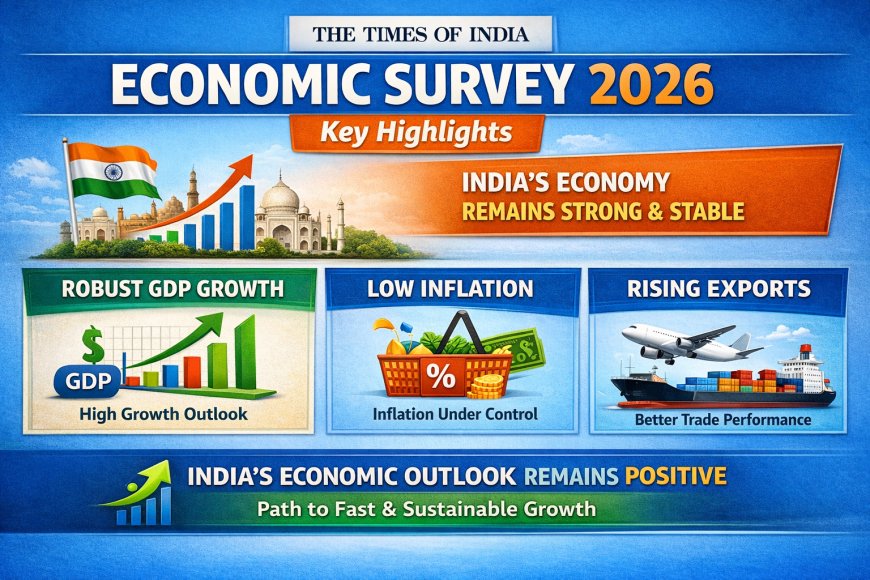
One of the biggest highlights in the Economic Survey 2026 is the GDP growth projection. The survey has pegged India’s real GDP growth for FY26 at 7.4%. This number is important because it shows that India is still among the fastest-growing major economies in the world.
A growth rate like 7.4% also reflects strong internal demand. It suggests that domestic consumption and investment are supporting the economy. When a country’s growth is driven mainly by domestic demand, it can remain more stable even if global trade slows down.
At the same time, the survey also recognises that global conditions are not fully stable. The world is dealing with trade restrictions, geopolitical tensions, and uncertain demand patterns. Even with these challenges, the survey’s growth outlook remains optimistic for India.
Read More:- TCS’s Brazil Bet Signals Next Phase of Indian IT
Inflation at Historic Lows: Better for People and Business
Inflation plays a big role in everyday life. When inflation is high, prices rise quickly, and household budgets come under pressure. The Economic Survey 2026 points out that inflation has been at historic lows, which is a strong indicator of economic stability.
Low inflation supports consumer confidence. People spend more when prices are stable, and that directly helps the economy grow. It also makes financial planning easier for families, especially in areas like food, fuel, rent, and essential items.
Businesses also benefit from lower inflation. Stable input prices help companies manage costs better, plan operations smoothly, and maintain margins. This creates a healthier environment for expansion and job creation.
Banking Sector Strengthens: Improved Balance Sheets and Credit Growth
A stable and strong banking sector is one of the most important requirements for long-term economic growth. According to the Economic Survey 2026, India’s banking system has improved in terms of stability, strength, and overall performance.
Better bank balance sheets allow banks to lend more confidently. When lending increases, businesses can expand, consumers can spend, and industries can invest in growth. Credit flow is especially important for sectors like MSMEs, manufacturing, real estate, and services.
The survey also suggests that credit growth has been healthy, showing strong demand for loans and better financial confidence in the economy. A positive banking environment supports long-term development because it gives businesses the funding they need to operate and scale.
Exports Improve Despite Global Tariff Pressures
Global trade is not easy at the moment. Many countries have increased tariffs or introduced trade restrictions to protect their domestic industries. This makes international business more complex and competitive.
Even in this difficult environment, the Economic Survey 2026 highlights that India’s exports have shown strength and improvement. This is significant because export growth supports industrial production and also brings foreign exchange into the country.
Exports are directly linked with job creation in sectors like manufacturing, textiles, engineering goods, IT services, and pharmaceuticals. When exports remain stable, it helps India maintain growth even if some global markets are slowing down.
The survey’s message is clear: India’s exporters have adapted well, but continuous improvement in competitiveness and supply chain efficiency will still be required for long-term success.
Global Risks Remain: Geopolitical and Trade Challenges
While the survey has a positive tone, it does not ignore global risks. The Economic Survey 2026 highlights that the global environment remains uncertain. Issues like geopolitical tension, supply chain disruptions, and trade fragmentation are still major concerns.
These challenges can impact India in multiple ways. Weak global demand can slow exports. Volatile commodity prices can increase import costs. Currency movements can make trade more expensive or unpredictable. Even changes in global interest rates can affect investor sentiment and international capital flow.
That is why the survey encourages a balanced approach. India needs to keep building domestic strength, but also stay prepared for external shocks.
What the Economic Survey 2026 Means Before the Budget
The Economic Survey is not just a report with numbers. It is often treated as a strategic guide for the upcoming Union Budget. The key highlights of the Economic Survey 2026 suggest that the government has room to push growth further, especially through investment-friendly policies and reforms.
The survey’s positive trends in GDP growth, inflation control, and banking strength can support a budget that focuses on:
- Infrastructure development
- Manufacturing and value addition
- Job creation programs
- Credit support for MSMEs
- Export competitiveness
- Stable economic reforms
With growth expected at 7.4%, inflation under control, and banks looking strong, the government can focus on improving productivity and long-term development rather than only crisis management.
Conclusion
Overall, the Economic Survey 2026 paints a hopeful picture of India’s economic progress. The survey projects GDP growth at 7.4%, points to inflation at historic lows, highlights stronger banks, and notes improvements in exports even amid global tariff challenges.
Even though global uncertainty remains, India’s strong domestic demand and improving financial stability provide confidence. The survey also sets the tone for the upcoming budget by showing where the economy is performing well and where further support is needed.
In simple words, the Economic Survey 2026 reflects resilience, growth potential, and a steady path forward for India’s economy.
What's Your Reaction?
 Like
0
Like
0
 Dislike
0
Dislike
0
 Love
0
Love
0
 Funny
0
Funny
0
 Angry
0
Angry
0
 Sad
0
Sad
0
 Wow
0
Wow
0

Vijay Chaudhary
I’m Vijay Chaudhary, a writer and author specializing in creative writing, blogs, and professional content. I write on business, ideas, and modern perspectives, focusing on clear, engaging, and well-structured storytelling. My goal is to create meaningful content that informs, connects, and adds real value for readers.