Tata Sons Chair Leads TCS AI Strategy Shift Sector
Tata Sons chairman steps in to drive TCS’s AI strategy as the IT leader pivots toward AI-led growth amid tech disruption and market shifts.
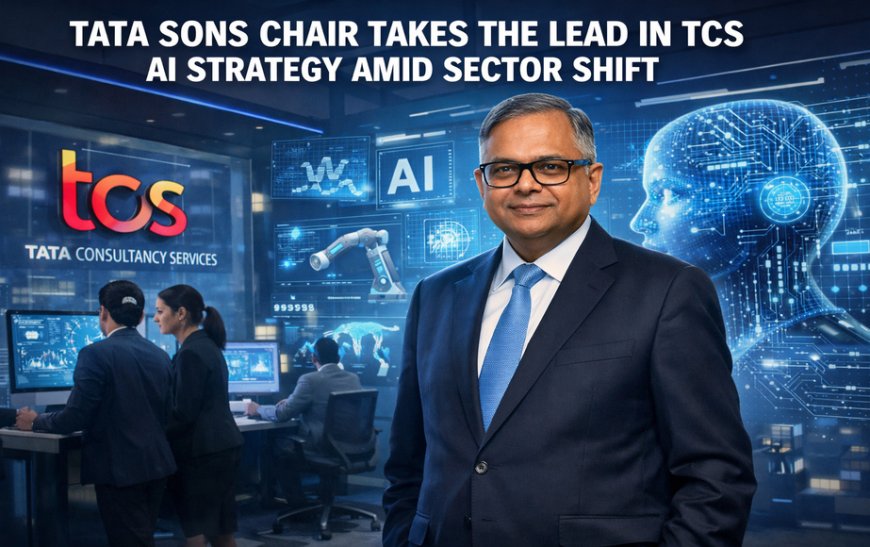
Tata Sons Chairman N. Chandrasekaran has taken a significantly more hands-on role in steering Tata Consultancy Services’ (TCS) response to the rapid industry transformation driven by artificial intelligence (AI). The move, prompted by intensifying competition from AI-native firms and volatility in IT equity markets, signals a strategic pivot aimed at fortifying TCS’s core business while accelerating its future-ready capabilities.
Strategic Reset at TCS Under N Chandrasekaran and the Rise of AI
Chandrasekaran’s increased involvement places him at the centre of TCS’s AI transformation agenda, with explicit emphasis on reshaping organisational priorities to reflect the evolving technology landscape. Sources indicate he has instructed senior leadership to strengthen AI capability building, integrate emerging solutions into client offerings, and safeguard TCS’s position as the Tata Group’s principal technology partner.
The renewed leadership focus arrives against the backdrop of intensifying global AI competition and a steep market correction in the IT sector equities, where major services firms, including TCS, experienced share price softness in early February 2026. Analysts linked part of this volatility to new AI offerings from non-traditional players that could disrupt traditional outsourcing and consulting revenue streams.
Timeline: Leadership Shift and Market Signals
The strategic redirection was publicly reported on 9 February 2026, when the Economic Times highlighted Chandrasekaran’s deeper engagement at TCS. Company insiders said the chairman is aligning leadership priorities to embed AI more firmly into the company’s service portfolio, workforce reskilling programmes, and execution frameworks.
Market data show that at the start of February, Indian IT stocks faced broad pressure following external AI vendor announcements, contributing to declines in the sector’s benchmark indices and raising investor questions about revenue models rooted in labour-intensive services.
Focus on AI Integration and Organisational Priorities
Under Chandrasekaran’s influence, TCS has been directed to prioritise AI integration into daily business processes while enhancing the firm’s ability to co-develop solutions with clients. According to recent reports, this includes internal calls for embedding AI tools across delivery units and reinforcing workforce training to match emerging demand profiles.
Industry trackers note that this leadership shift complements TCS's existing investments in AI-centric infrastructure and services. In prior quarters, TCS secured significant capital for AI data centre development and has signalled openness to strategic partnerships and acquisitions to accelerate capability building.
Data and Financial Context
TCS remains one of India’s largest revenue generators within the Tata Group, accounting for a substantial share of consolidated dividend income for the holding company. Recent market movements have underscored the urgency for the company to future-proof its traditional service lines and optimise margins amid global technology shifts.
While full-year financial figures for FY26 lie ahead, prior fundraising and infrastructure commitments — including private equity-backed investments exceeding $1 billion in AI-related data centre capacity — reflect the company’s effort to broaden its portfolio beyond conventional application management services.
Market Impact and Stakeholder Reaction
Initial market reactions to Chandrasekaran’s strategic involvement have been mixed. Some analysts believe the move will reassure investors about TCS’s long-term relevance, given the firm’s standing in a technology services market exceeding $300 billion globally. Brokers tracking Indian IT equities assert that an intensified AI focus could mitigate valuation pressures linked to perceived competitive threats.
Corporate governance watchers also note that strong executive engagement at the top is a signal of urgency internally, particularly as rival firms and ecosystems invest aggressively in generative and workflow-level AI tools.
Forward Outlook Based on Official Statements
While TCS has yet to disclose a detailed AI execution roadmap publicly, comments from senior leadership at internal conferences emphasise embedding advanced technology in everyday operations and reconsidering traditional talent frameworks to meet future client expectations.
Chandrasekaran’s expanded role could therefore shape not only strategy but also execution discipline as TCS recalibrates its service offerings. Such moves may include asset reshaping, targeted acquisitions, and partnerships aimed at expanding its AI-enabled services footprint across industries.
What's Your Reaction?
 Like
0
Like
0
 Dislike
0
Dislike
0
 Love
0
Love
0
 Funny
0
Funny
0
 Angry
0
Angry
0
 Sad
0
Sad
0
 Wow
0
Wow
0

Kulshreshth Chaturvedi
I’m Kulshreshth Chaturvedi, a writer and author specialising in creative writing, blogs, and professional content. I write on literature, ideas, and modern perspectives, focusing on clear, engaging, and well-structured storytelling. My goal is to create meaningful writing that inspires readers, builds connections, and delivers real value through words.