























































































































































































The Rise of India’s Digital Public Infrastructure as a Global Blueprint
India’s Digital Public Infrastructure (Aadhaar, UPI, ONDC) is transforming inclusion, innovation, and global digital governance.

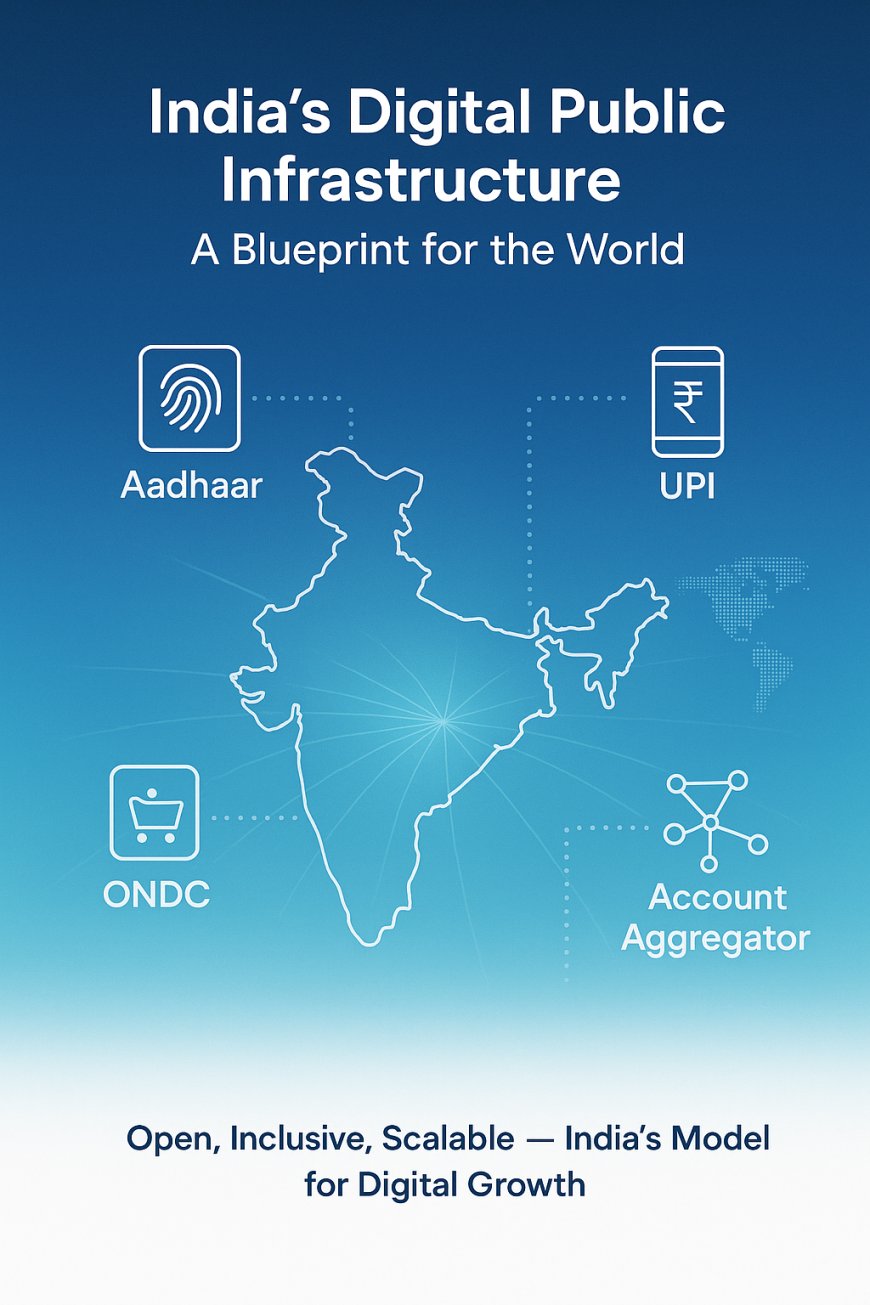
When the world talks about innovation, it often looks toward Silicon Valley’s private tech giants — Google, Apple, Meta. But India’s biggest technological leap didn’t come from private enterprise. It came from the public digital infrastructure quietly transforming everyday life for over a billion people.
Digital Public Infrastructure (DPI) refers to open, interoperable digital systems — built by the state, adopted by the private sector, and accessible to all citizens. These platforms enable inclusion and innovation at a scale no country has achieved before.
At the heart of this transformation lies India Stack — a layered set of technologies that includes:
- Aadhaar, the world’s largest biometric digital identity system
- UPI, the instant real-time payments network connecting every bank and fintech
- DigiLocker, which stores verified digital documents
- Account Aggregator, which gives individuals secure control over their financial data
Together, these form a digital backbone that has made financial inclusion, identity verification, and public service delivery faster, cheaper, and more transparent.
The impact? Over a billion Indians can now access financial, social, and economic services digitally — from village entrepreneurs accepting UPI payments to students downloading verified certificates in seconds. India’s DPI story is not about apps; it’s about access, equity, and empowerment.
What Is Digital Public Infrastructure?
Digital Public Infrastructure (DPI) is the new foundation of the digital economy — a set of interoperable platforms that governments, businesses, and citizens can all build upon. Unlike proprietary digital ecosystems controlled by corporations, DPI is open, inclusive, and designed for public good.
Think of DPI as the digital equivalent of roads and electricity — infrastructure that enables everyone to participate in the modern economy.
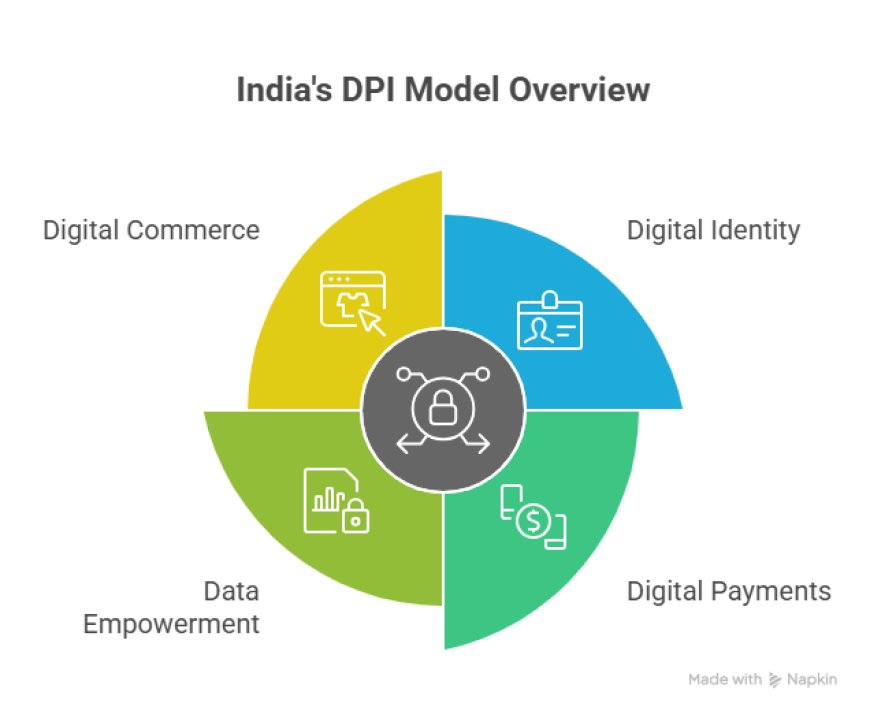
India’s DPI model is built on four key pillars:
1. Digital Identity — Aadhaar:
The base layer providing every citizen with a unique, verifiable identity. It enables seamless KYC, targeted welfare delivery, and financial inclusion.
2. Digital Payments — UPI:
The transaction layer that allows instant money transfers across banks, apps, and platforms. It has turned India into the world’s largest real-time payments market.
3. Data Empowerment — Account Aggregator & DigiLocker:
These systems give individuals ownership and portability of their data. They allow secure sharing of verified documents and financial records — with consent and transparency.
4. Digital Commerce — ONDC (Open Network for Digital Commerce):
The latest layer enabling small retailers and sellers to participate in e-commerce on equal terms with large platforms.
Collectively known as India Stack, this architecture represents an open, modular approach to digital nation-building. It allows both the public and private sectors to innovate on top of shared digital rails — enabling solutions that are inclusive by design, scalable by technology, and sustainable by governance.
India’s DPI is not just a digital transformation — it’s a governance innovation that’s redefining how technology can serve society.
India’s DPI Journey: From Identity to Inclusion
India’s digital transformation didn’t happen overnight — it unfolded in deliberate layers, each solving a foundational challenge and setting the stage for the next.
Aadhaar laid the groundwork as the world’s largest digital identity system, giving over 1.3 billion citizens a unique, verifiable digital ID. It made direct benefit transfers (DBT) possible, cutting out middlemen and ensuring subsidies reached the right people. It also revolutionized KYC, enabling millions of Indians to open bank accounts and access formal finance for the first time.
Then came UPI (Unified Payments Interface) — the system that democratized digital payments. Whether it’s a local kirana store or a multinational enterprise, UPI created a common platform where transactions are instant, free, and interoperable. It turned mobile phones into micro-payment gateways, making digital money truly universal.
DigiLocker added the next layer of trust — a secure vault for verified documents such as driving licenses, educational certificates, and government IDs. Citizens can now share authenticated digital copies instead of physical paperwork, simplifying verification for everything from jobs to services.
With Account Aggregator, India introduced a global first: data empowerment architecture that allows individuals to securely share their financial data across institutions — with full consent and transparency. It’s reshaping credit access, enabling small businesses and individuals to prove financial trustworthiness in seconds.
Finally, ONDC (Open Network for Digital Commerce) is bringing the same openness to e-commerce. It’s a protocol that allows small merchants, local stores, and startups to compete on equal terms with big platforms by breaking the walled-garden model of digital retail.
Together, these platforms form a digital flywheel for inclusion and innovation — where identity enables access, payments drive participation, data unlocks opportunity, and commerce powers growth.
Impact on the Indian Economy
The impact of India’s Digital Public Infrastructure is visible across every layer of the economy — from financial inclusion to government efficiency and private-sector innovation.
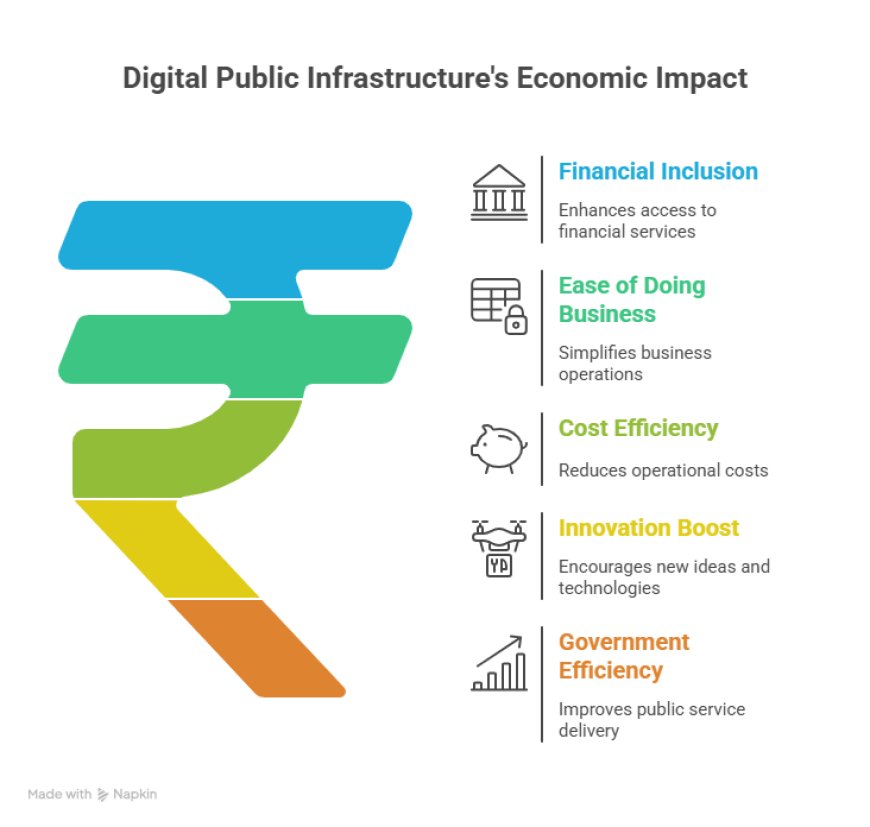
1. Financial Inclusion:
UPI has become the great equalizer of the digital age, bringing millions of first-time users into the formal financial system. Small merchants, farmers, and gig workers are now part of a seamless, low-cost digital economy that was once inaccessible to them.
2. Ease of Doing Business:
e-KYC, instant payments, and digital verification have drastically reduced friction in business operations. Startups can onboard customers in minutes, and enterprises can transact securely without manual paperwork or delays.
3. Cost Efficiency:
DPI has redefined the economics of digital transactions. What once cost several rupees per verification or transfer now happens at near-zero marginal cost. This efficiency allows both governments and businesses to serve more people at lower costs.
4. Innovation Boost:
Open APIs and interoperable infrastructure have sparked a wave of innovation. Fintechs, healthtech startups, and even edtech platforms are building new solutions on top of these public rails — turning India into a global testbed for digital innovation at scale.
5. Government Efficiency:
Public service delivery has become faster, more transparent, and less prone to leakages. Direct transfers, identity-based targeting, and real-time verification have reshaped how welfare programs reach citizens — improving both reach and accountability.
In short, DPI is not just digitizing India’s economy — it’s decentralizing opportunity. It’s a model where technology isn’t the end goal, but the means to achieve a more inclusive, efficient, and resilient society.
Global Influence: India as a DPI Exporter
What started as India’s internal digital transformation is now becoming a global public good. Across Asia, Africa, and Latin America, nations are studying — and in many cases, actively adopting India’s DPI blueprint to drive inclusion, transparency, and innovation at population scale.
The most visible example of this global influence is the India–Singapore UPI linkage, which enables instant cross-border payments between citizens of both countries. It’s not just about remittances — it’s proof of concept that interoperable digital systems can work beyond national borders.
Through initiatives like India Stack Global, the G20 Digital Public Infrastructure (DPI) framework, and Digital India partnerships, India is now helping other nations design their own secure and scalable digital layers. Countries such as Kenya, Philippines, Indonesia, and Morocco are exploring identity, payment, and data-sharing models inspired by India’s approach.
This transformation marks India’s emergence as a thought leader in digital public goods — where open standards and inclusive architecture are prioritized over proprietary systems. Instead of exporting software, India is exporting systems thinking — showing the world how digital ecosystems can work for all, not just for profit.
In a global context of tech monopolies and data silos, India’s DPI model offers something radical: sovereign digital empowerment that balances innovation with public trust.
The Private Sector’s Role
While the foundation of India’s DPI is public, its success story is deeply intertwined with private-sector collaboration. The approach is not “government versus startups,” but rather co-creation through open rails — where enterprises innovate on top of shared infrastructure.
Take fintech apps as an example. Platforms like PhonePe, Paytm, Google Pay, and CRED were able to scale rapidly because they built on UPI’s open payment rails. Instead of reinventing core systems, they innovated at the user experience layer — making digital payments seamless for consumers and merchants alike.
Similarly, e-commerce players are beginning to integrate with ONDC (Open Network for Digital Commerce). This allows even small businesses and local stores to reach customers across platforms, breaking the dependency on a few large marketplaces. It’s inclusivity through interoperability — where everyone competes on service, not just market dominance.
Banks and NBFCs are also embracing the Account Aggregator framework, which enables data-driven credit underwriting. For the first time, consent-based financial data sharing allows lenders to assess borrower risk more accurately — expanding credit access for MSMEs and individuals with limited history.
In this ecosystem, open standards fuel private innovation. DPI provides the infrastructure; startups and businesses provide the creativity, customer insight, and agility to build products that scale.
This public–private symbiosis is what makes India’s DPI movement truly unique — a living collaboration between policy, technology, and entrepreneurship.
Challenges to Overcome
India’s Digital Public Infrastructure (DPI) success story is remarkable — but sustaining it at national scale requires addressing key structural and ethical challenges.
1. Data Privacy & Security Concerns
With millions of transactions, identities, and digital records being processed daily, data protection remains a foundational concern. DPI systems must ensure that citizen data is not only encrypted but also governed through clear consent frameworks, audit trails, and accountability mechanisms.
2. Digital Literacy Gaps
The power of DPI can only be realized when citizens can confidently use it. India still faces wide digital literacy disparities, especially across rural and semi-urban populations. Bridging this gap through awareness, user-friendly design, and vernacular interfaces will be essential for truly inclusive adoption.
3. Infrastructure Inequality
Not all regions have consistent internet connectivity or reliable digital infrastructure. Low-connectivity zones risk being excluded from DPI benefits unless complemented with investment in last-mile connectivity and resilient digital networks.
4. Balancing Openness with Regulation
DPI thrives on open architecture, but openness must coexist with responsible governance. Ensuring interoperability without misuse or monopolization demands agile regulatory oversight that evolves as fast as the technology itself.
5. Sustaining Trust in Digital Identity
Aadhaar and related systems rely on citizen trust. Preventing misuse, fraud, or unauthorized data sharing is critical to maintaining confidence in these systems. The challenge lies in designing safeguards that protect privacy while enabling innovation.
In essence, India’s DPI journey must now evolve from “build and deploy” to “secure and sustain” — ensuring that digital inclusion goes hand in hand with digital rights.
The Future: DPI as a Global Public Good
As India’s DPI matures, the next chapter is not just domestic success — it’s global leadership. The country is now positioning itself as a knowledge and implementation hub for nations seeking scalable, inclusive digital transformation.
The concept of DPI as a “global public good” is gaining traction. Just as the Bretton Woods institutions shaped the financial order of the 20th century, India’s DPI framework could inspire a “Digital Bretton Woods” — shared, interoperable digital infrastructure for identity, payments, and data exchange across countries.
This model is already expanding beyond finance into new domains:
- Healthcare: Ayushman Bharat Digital Mission (ABDM) aims to unify medical records and enable patient-controlled data sharing.
- Education: DIKSHA provides open digital learning resources for teachers and students nationwide.
- Logistics & Supply Chains: ULIP (Unified Logistics Interface Platform) integrates transport and warehousing data for real-time visibility.
- Governance & Services: From e-signatures to online grievance redressal, DPI is streamlining how citizens interact with the state.
The next decade of India’s digital economy will be built atop this stack — where financial, social, and governance data flow seamlessly and securely.
Globally, India’s DPI playbook demonstrates that innovation and inclusion can coexist. It’s not just about building digital systems — it’s about creating digital sovereignty, where nations own and operate the rails of their digital economies.
As the world watches, India’s DPI story is evolving from national infrastructure to a template for equitable digital globalization.
Conclusion
India’s Digital Public Infrastructure (DPI) represents one of the most ambitious digital transformations in the world — built not by corporations, but through public innovation at population scale.
From Aadhaar to UPI to ONDC, India has proven that open, interoperable systems can drive both economic growth and social inclusion. The impact extends beyond convenience — it redefines how citizens access services, how businesses innovate, and how governments deliver.
The next phase of India’s journey will focus on deepening trust, expanding global collaboration, and evolving governance frameworks that keep DPI ethical, secure, and citizen-first.
As nations seek models for digital inclusion, India’s blueprint offers a compelling vision — that technology, when designed as a public good, can democratize opportunity for billions.
DPI isn’t just infrastructure — it’s the digital backbone of a more connected, equitable future.
What's Your Reaction?
 Like
0
Like
0
 Dislike
0
Dislike
0
 Love
0
Love
0
 Funny
0
Funny
0
 Angry
0
Angry
0
 Sad
0
Sad
0
 Wow
0
Wow
0