Budget 2026: How can the “Four Pillars of Growth” support India Inc.?
Budget 2026 focuses on infrastructure, value addition, green transition, and MSME credit to boost India Inc, jobs, investment and growth.
The Indian economy is at a crucial juncture. Businesses today need both rapid growth and stability. Due to global demand fluctuations, supply chain issues, and intense competition, companies have to manage both cost control and expansion. In such times, expectations from Budget 2026 are high, with hopes that the government will announce measures that support growth, boost investment, and accelerate job creation.
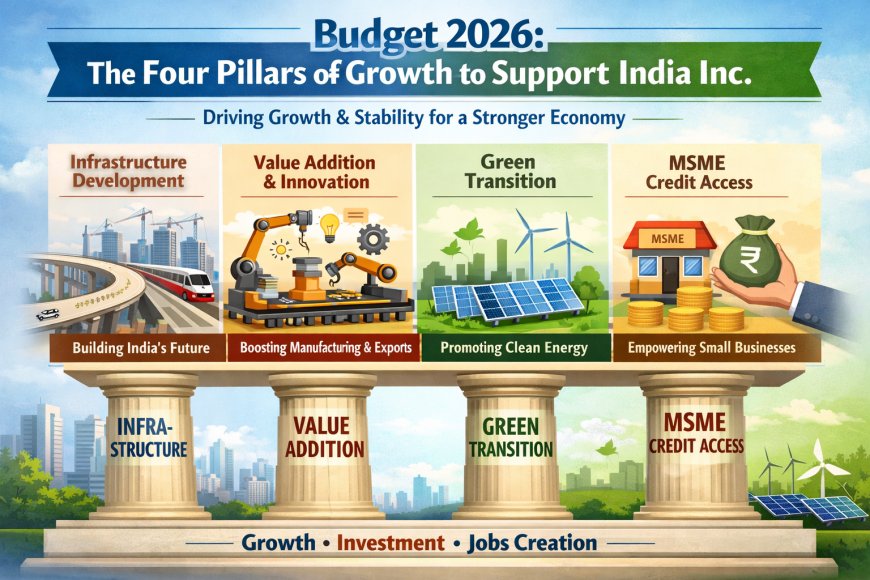
An analysis by the Economic Times suggests that Budget 2026 should adopt a practical approach, focusing on four key areas to support growth. These are referred to as the “Four Pillars of Growth.” These four areas are: Infrastructure, Value Addition, Green Transition, and MSME Credit Access.
If Budget 2026 provides a strong impetus to these four pillars, India Inc. can get a clear direction for growth.
1) Infrastructure: A strong foundation leads to faster business growth
Infrastructure has a direct connection to business costs and delivery speed. When roads, railways, ports, airports, and power supply systems are robust, the movement of raw materials becomes easier, and finished products reach the market more quickly. This saves companies time and reduces operational costs.
Logistics costs in India are still considered quite high, which puts extra pressure on manufacturing and exports. If Budget 2026 further strengthens highways, rail freight, port connectivity, and warehousing, companies will receive a direct advantage.
The government's focus on capital expenditure (Capex) has been strong in the last few budgets, and continuing this approach can be beneficial for India. Infrastructure investment increases activity in sectors like construction, cement, steel, and transport, impacting both employment and the local economy.
2) Value Addition: Taking “Make in India” to the next level
India is making significant progress towards becoming a manufacturing hub, but growth is stronger when the country doesn't solely depend on assembly. Real profitability and long-term strength come when high-value components, design, technology, and innovation are developed locally.
Sectors like electronics, EV components, semiconductors, and defence manufacturing have significant scope for value addition. If Budget 2026 promotes domestic production, develops supply chains, and strengthens the manufacturing ecosystem, India's import dependency can be reduced.
One benefit of value addition is seen in exports. When a larger portion of the product is manufactured in India, the export value increases, and competitiveness in the global market improves. This also has a long-term impact on jobs and the demand for a skilled workforce, as manufacturing requires trained manpower.
3) Green Transition: Clean energy, cost control, and future growth
Clean energy and the green transition are no longer optional topics. Renewable energy, EV adoption, and sustainable manufacturing are receiving priority globally. India is also actively moving into sectors like solar, wind, EVs, and green hydrogen.
If Budget 2026 supports renewable projects, battery storage, EV charging infrastructure, and green hydrogen, India's green ecosystem can develop rapidly. One practical advantage of this is that in the long term, the pressure of fuel imports can be reduced, and energy security can be improved.
The green transition also brings a new wave of business opportunities. Private investment increases in sectors like EV manufacturing, charging stations, recycling, clean tech, and energy-efficient products. This also provides new opportunities for startups and MSMEs.
Another strong point of the green push is that today's consumers are also starting to prefer sustainable products. Businesses that adopt sustainability strengthen their brand value and long-term market positioning.
4) MSME Credit Access: Small businesses grow, and when they grow, the economy grows.
India's MSMEs are the backbone of the economy. This sector plays a major role in manufacturing, services, trading, and local employment. However, MSMEs face a common issue: a shortage of working capital and affordable credit.
When small businesses don't receive timely loans, production slows down, expansion halts, and the business growth cycle is disrupted. Therefore, improving credit access for MSMEs in Budget 2026 could be a high-impact step.
Solutions like credit guarantee schemes, faster loan approvals, digital lending support, and invoice-based financing can become growth drivers for MSMEs. Additionally, controlling delayed payments from the government and large companies can provide MSMEs with cash flow stability.
When the MSME sector is strong, jobs are naturally created, as small businesses employ more manpower. If Budget 2026 simplifies the financing and compliance processes for MSMEs, both business confidence and growth will improve.
Expectations from Budget 2026: A balance of growth and stability
The purpose of Budget 2026 should not only be to provide short-term relief but also to create a stable roadmap for long-term growth. Spending on infrastructure will improve logistics, a push for value addition will strengthen the manufacturing ecosystem, a green transition will create a future-ready economy, and MSME credit support will bring growth at the grassroots level.
India's growth outlook is already considered strong globally. If the government focuses on execution in these four pillars, India Inc. will gain the confidence to expand, and international investors will see long-term opportunities in India.
Conclusion
Overall, Budget 2026 is a strong opportunity for India to drive growth through a "planning + execution" model. Through the "Four Pillars of Growth" approach, the government can provide India Inc. with cost-effective operations, faster expansion, better financing, and future-ready opportunities.
If these four areas become a priority in Budget 2026, India's economic growth engine can become even more stable, competitive, and sustainable.
What's Your Reaction?
 Like
0
Like
0
 Dislike
0
Dislike
0
 Love
0
Love
0
 Funny
0
Funny
0
 Angry
0
Angry
0
 Sad
0
Sad
0
 Wow
0
Wow
0

Vijay Chaudhary
I’m Vijay Chaudhary, a writer and author specializing in creative writing, blogs, and professional content. I write on business, ideas, and modern perspectives, focusing on clear, engaging, and well-structured storytelling. My goal is to create meaningful content that informs, connects, and adds real value for readers.