






























































































































































Which Fundamental Force Binds Quarks Together Inside Protons and Neutrons?
Learn which fundamental force is responsible for holding quarks tightly together inside protons and neutrons. Understand the role of the strong nuclear force in particle physics.
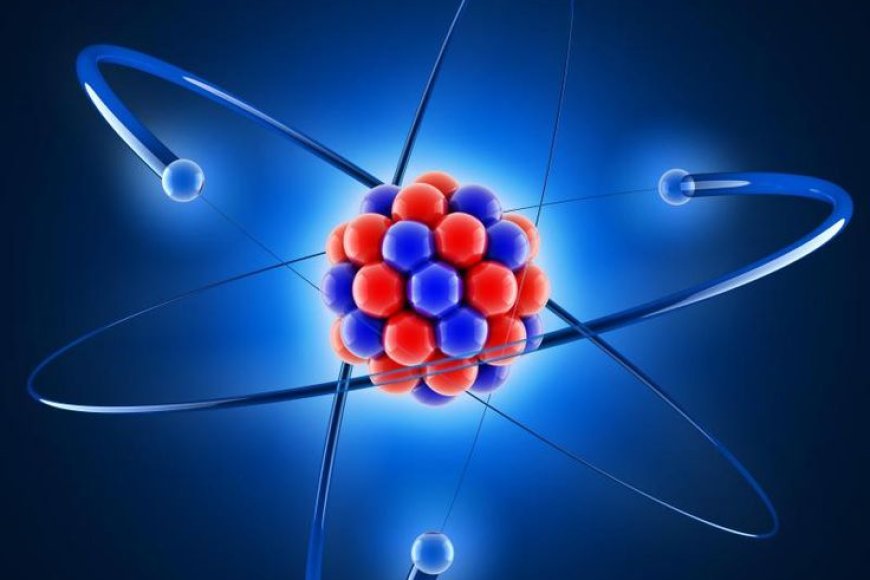
1. Which fundamental force is responsible for binding quarks together inside protons and neutrons?
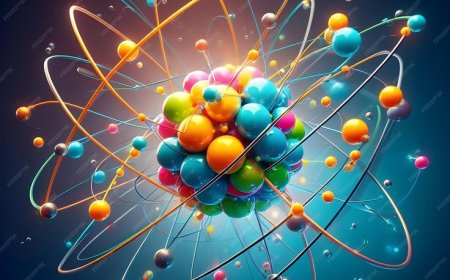
The image is a bright, glowing 3D illustration of an atom. At the center is a spherical nucleus made up of red and blue particles, representing protons and neutrons clustered tightly together. Surrounding the nucleus are smooth, curved orbital paths shown as glowing blue loops. Small blue spheres representing electrons are positioned along these orbiting paths. The background is a deep blue gradient, creating a striking contrast that makes the atom appear illuminated and energetic. The overall design visually represents atomic structure in a modern, scientific, and futuristic style
2. Which law explains why a rocket moves forward when gases are expelled backward?
The image shows a powerful rocket blasting off into the sky, leaving behind a massive plume of bright orange flames and thick clouds of smoke. The rocket is rising quickly, cutting through the early evening sky filled with soft clouds and warm light. The fire from the engines glows intensely, illuminating the ground below and creating a dramatic contrast against the darkening blue sky. The scene captures the energy, speed, and excitement of a space launch, symbolizing exploration, innovation, and human achievement.

3. Which particle has zero rest mass?
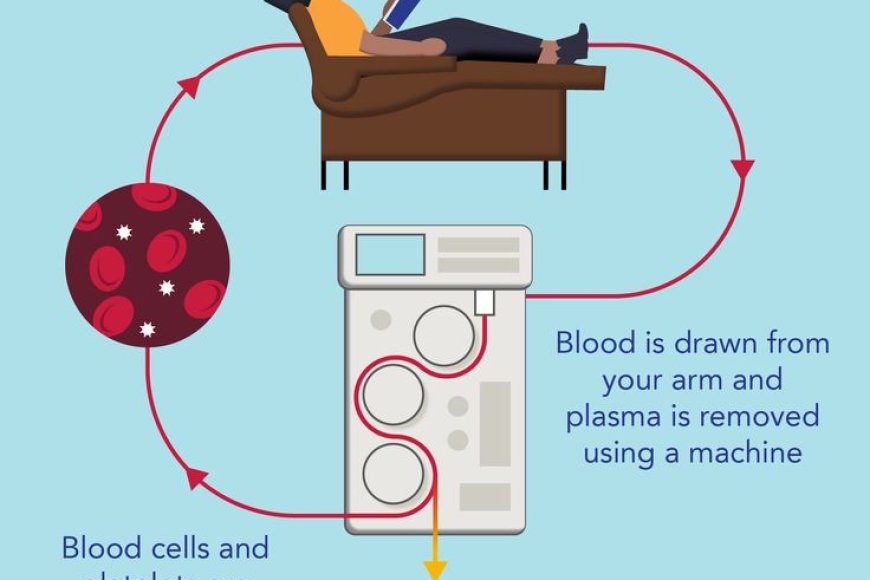
The image is an illustrated infographic explaining the process of plasmapheresis. At the top, the title “Plasmapheresis” is written in large text along with its pronunciation (plaz-muh-feh-ree-sis).
Below the title, a sentence explains that plasmapheresis is the process of removing plasma from blood for donation.
The illustration shows a person lying comfortably on a recliner chair while donating blood. A red arrowed flow path visually represents how blood travels from the donor’s arm to a medical machine. The machine separates plasma from the blood.
On the left side, there is a circular drawing of blood cells. On the right, text explains: “Blood is drawn from your arm and plasma is removed using a machine.”
Another arrow shows that blood cells and platelets are returned to the donor after plasma is separated. At the bottom, a yellow container labeled “PLASMA” shows the collected plasma, with text next to it reading “Plasma is collected!”
What's Your Reaction?
 Like
1
Like
1
 Dislike
0
Dislike
0
 Love
0
Love
0
 Funny
1
Funny
1
 Angry
0
Angry
0
 Sad
0
Sad
0
 Wow
1
Wow
1