Economic Survey 2025–26: What Does 6.8–7.2% Growth Mean ?
India’s Economic Survey 2025–26 projects GDP growth of 6.8–7.2%. Explore what this outlook signals for India’s economy, policy priorities, and growth path over the next three years.
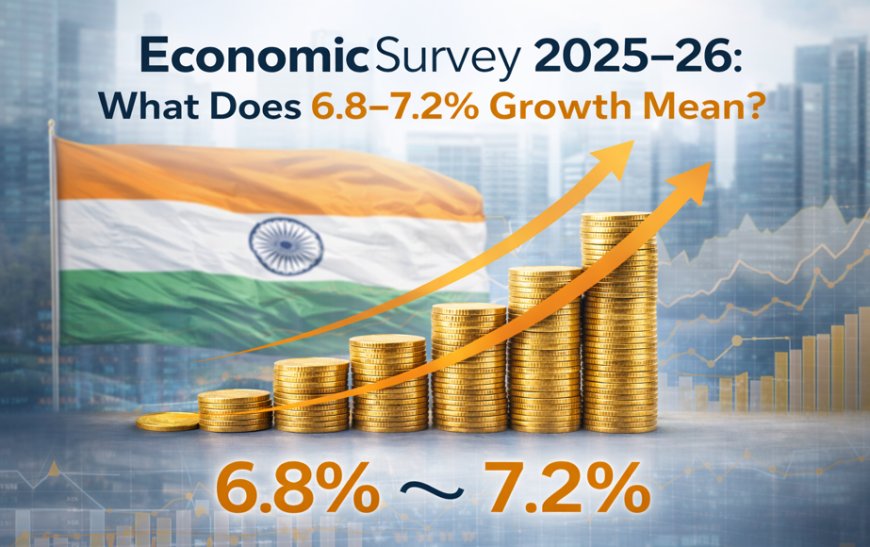
India’s Economic Survey 2025–26 has placed the country’s expected economic growth for the coming year between 6.8% and 7.2%. Released ahead of the Union Budget, the Survey provides an official snapshot of how the government views the economy’s current position and near-term prospects. While the figure has attracted attention for its precision, its real value lies in what it reveals about the balance between confidence and caution shaping India’s economic outlook.
This growth range does not exist in isolation. It reflects assumptions about domestic demand, investment behaviour, global conditions and policy priorities. To understand what the projection truly means, it is important to look beyond the headline number and examine how the next three years may unfold.
A Signal of Stability, Not Acceleration
Compared with the estimated growth of over 7% in the current financial year, the projection for 2025–26 suggests a slight moderation rather than a slowdown. This distinction matters. It indicates that policymakers expect the economy to remain stable, even as it navigates external pressures such as slower global trade, geopolitical uncertainty and tighter financial conditions in some major economies.
At a time when many large economies are struggling to sustain growth, a range close to 7% positions India among the faster-growing nations globally. However, the Survey also avoids overstating momentum, recognising that maintaining high growth rates consistently becomes harder as the economy expands.
Domestic Demand Continues to Anchor Growth
One of the clearest messages in the Survey is the continued reliance on domestic demand. Private consumption remains the backbone of economic activity, supported by steady urban spending and a gradual improvement in rural demand. Household consumption is expected to remain resilient over the next three years, provided employment conditions remain supportive.
That said, consumption-led growth brings its own challenges. Without sufficient job creation and income growth, demand can weaken. The projection assumes that employment, particularly in services and small enterprises, will expand steadily enough to sustain spending. This emphasises policies that encourage labour-intensive growth rather than relying solely on capital-heavy sectors.
Investment: The Deciding Factor
Public investment has played a major role in recent years, especially through infrastructure spending on transport, logistics and urban development. The Survey’s growth range assumes that this momentum will continue, providing a foundation for broader economic activity.
The more critical question for the next three years is whether private investment follows suit. Businesses tend to invest when demand is predictable, financing costs are manageable and regulatory conditions are stable. If private capital expenditure strengthens meaningfully, growth could edge towards the upper end of the projected range. If it remains cautious, growth may hold, but feel less broad-based.
Services Remain the Most Reliable Contributor
India’s services sector continues to do much of the heavy lifting. Information technology, financial services, communications and professional services have shown consistent expansion and remain important sources of employment and export earnings.
The Survey’s projection reflects confidence that services will continue to perform well, even if manufacturing faces uneven global demand. Over the next three years, the challenge will be to extend services-led growth beyond major urban centres, ensuring that its benefits reach a wider population.
Manufacturing Progress, But With Limits
Manufacturing remains a focus area, but expectations are measured. While certain segments have benefited from policy support and shifting global supply chains, manufacturing growth has not yet become uniformly strong.
The 6.8–7.2% growth range suggests incremental improvement rather than a sharp transformation. Over the medium term, manufacturing’s contribution will depend on its ability to generate stable employment and integrate more deeply into global value chains, rather than relying on short-term incentives.
Global Conditions Shape the Ceiling
External factors quietly influence the growth outlook. Sluggish global demand, trade tensions and geopolitical risks constrain export growth and capital flows. The Survey’s upper growth estimate reflects optimism tempered by these realities.
Services exports offer some protection against weak global goods trade, but they cannot fully offset prolonged external slowdowns. Over the next three years, India’s growth will depend more on domestic resilience than on favourable global conditions.
Inflation and Policy Balance
The growth projection assumes that inflation remains broadly manageable. Price stability is essential for sustaining growth without forcing abrupt policy changes. If inflation rises sharply due to food prices, energy costs or currency pressures, monetary policy may need to remain tighter for longer.
This creates a delicate balance. Supporting growth while maintaining price stability will define economic management over the coming years. The Survey suggests confidence in this balancing act, but acknowledges that risks remain.
Employment: The Real Test of Growth
Headline growth figures often mask deeper concerns about employment. A near-7% economy that fails to generate enough jobs risks social and economic strain. The Survey’s projection implicitly assumes that employment will grow in line with output, particularly in services, construction and small businesses.
Over the next three years, the success of the growth outlook will be judged less by GDP numbers and more by job creation. Without sufficient employment growth, the benefits of expansion may feel uneven.
What the Next Three Years May Hold
Taken together, the 6.8–7.2% projection points to a period of consolidation rather than rapid acceleration. The economy is expected to grow steadily, supported by domestic demand, public investment and services, while managing external uncertainty and internal constraints.
If reforms deepen, private investment responds and employment expands meaningfully, growth could approach the higher end of the range. If these conditions weaken, growth may remain stable but less transformative.
Conclusion
The Economic Survey 2025–26 offers a realistic assessment rather than an ambitious promise. A growth range of 6.8–7.2% reflects confidence in India’s underlying strength, alongside recognition of the challenges that lie ahead. Over the next three years, the focus will shift from simply sustaining growth to ensuring that it becomes broader, more inclusive and more durable.
In that sense, the projection is not just a forecast. It is a reminder that steady progress, supported by careful policy choices and responsive investment, will shape India’s economic path in the years to come.
What's Your Reaction?
 Like
0
Like
0
 Dislike
0
Dislike
0
 Love
0
Love
0
 Funny
0
Funny
0
 Angry
0
Angry
0
 Sad
0
Sad
0
 Wow
0
Wow
0