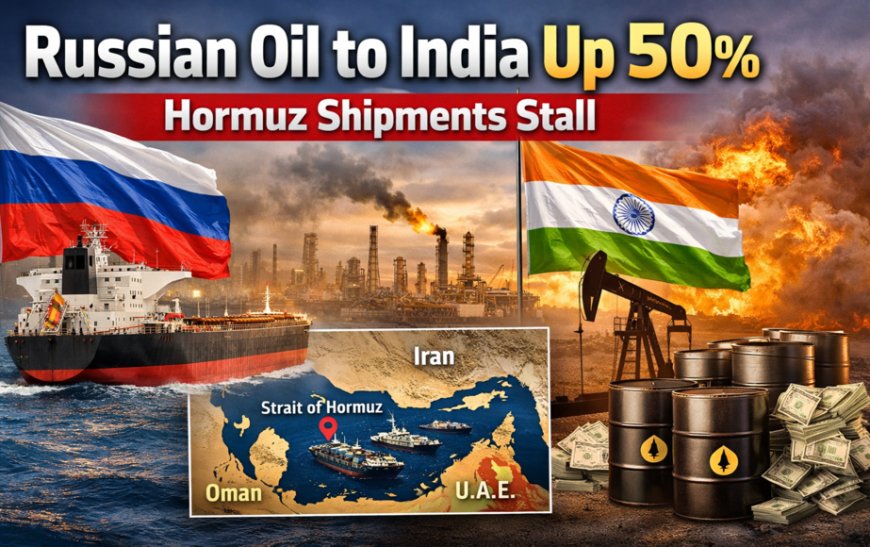
Russian Oil to India Up 50% Hormuz Shipments Stall
Russian oil shipments to India jump 50% as Middle East tensions disrupt Hormuz shipping, pushing buyers to rely more on Russian crude supplies worldwide demand.
The ongoing geopolitical tensions in the Middle East have begun to affect global energy supply chains, prompting many countries to reassess their crude oil sourcing strategies. One of the most significant developments arising from this crisis is the sharp increase in Russian crude inflows to India, as Indian refiners rapidly secure alternative oil supplies.
India is currently the third-largest oil importer in the world, and its energy demand continues to rise with economic growth, urbanisation, and industrial expansion. According to data from the International Energy Agency (IEA) and industry reports, India consumes nearly 5.8 million barrels of oil per day, and almost 88% of this demand is met through imports. Because of this heavy dependence on imported crude oil, any disruption in global oil trade routes can have a direct impact on the country’s energy security.
The recent disruption in oil shipments through the Strait of Hormuz, one of the world’s most critical maritime oil routes, has slowed supplies from several Middle Eastern oil producers. As a result, Russian crude inflows into India have surged significantly, helping Indian refiners maintain steady fuel supplies.
Russian crude inflows to India surge as Hormuz shipments slow
Recent shipping data indicates that Russian crude inflows to India increased by nearly 50% during March 2026 compared with the previous month. Imports rose from around 1.04 million barrels per day in February to nearly 1.5 million barrels per day in early March.
This sudden rise has largely been triggered by disruptions in Middle Eastern oil shipments. The Strait of Hormuz, located between Iran and Oman, handles a large portion of the world’s oil exports. According to the U.S. Energy Information Administration (EIA), nearly 20% of global petroleum liquids pass through this narrow shipping route every day.
For India, the route is even more important. Approximately 40% of India’s crude oil imports pass through the Strait of Hormuz, making it a vital energy supply corridor. When tanker movement slowed due to security risks and rising regional tensions, Indian refiners had to quickly look for alternative oil suppliers.
This situation resulted in a rapid increase in Russian crude inflows to India, ensuring that domestic fuel supply chains continued without major disruptions.
India’s dependence on imported crude oil remains high.
India’s domestic oil production is limited compared to its rapidly growing oil consumption. According to government and industry estimates, the country produces only a small portion of the oil it consumes.
Key facts highlighting India’s dependence on global oil markets include:
• India consumes around 5.8 million barrels of oil per day
• Nearly 88% of India’s crude demand is met through imports
• A large share of these imports traditionally comes from Middle Eastern countries such as Iraq, Saudi Arabia, and the UAE
• Nearly 88% of India’s crude demand is met through imports
• A large share of these imports traditionally comes from Middle Eastern countries such as Iraq, Saudi Arabia, and the UAE
Due to this dependency, any geopolitical conflict or shipping disruption in oil-producing regions can impact India’s energy supply chain and fuel pricing stability.
The recent Middle East supply disruption has clearly demonstrated this vulnerability. As shipments from the Gulf region slowed, Indian refiners increased purchases from Russia, causing Russian crude inflows into India to rise sharply within a short period.
Russia strengthens its position as a key oil supplier to India.
Russia has gradually become one of India’s most important crude oil suppliers in recent years. After Western sanctions on Russia following the Ukraine conflict in 2022, Moscow started offering significant discounts on Russian crude oil exports.
These discounted prices made Russian crude oil highly attractive for Indian oil refiners. According to global energy analytics data, Russia has frequently remained India’s largest crude oil supplier, accounting for nearly 30–34% of India’s total crude imports during several months over the past two years.
The price advantage of Russian crude has helped Indian refiners improve refining margins while keeping domestic fuel prices relatively stable.
The current rise in Russian crude inflows to India is therefore not just a response to supply disruptions but also a reflection of economic practicality in global oil markets.
Indian refiners secure additional Russian cargoes.
India’s largest private and public sector oil refiners have acted quickly to secure additional Russian crude cargoes following the Middle East oil supply disruption.
Reports suggest that Reliance Industries, one of India’s biggest refining companies, purchased nearly 6 million barrels of Russian crude for March deliveries. Other Indian oil refiners also increased their purchases to ensure uninterrupted refinery operations.
Industry sources estimate that Indian refiners collectively secured more than 10 million barrels of additional Russian crude cargoes to offset delays in Middle Eastern oil shipments.
These purchases have significantly boosted Russian crude inflows into India, highlighting how India’s energy companies are adapting to rapid changes in global oil markets.
Global oil trade patterns are shifting.
The increase in Russian crude inflows to India reflects broader changes in global oil trade patterns. Over the past few years, geopolitical tensions, sanctions, and shifting trade alliances have reshaped the way crude oil flows across global markets.
After Western nations reduced their imports of Russian oil, Moscow redirected a large portion of its oil exports toward Asian markets, particularly India and China.
This shift created new energy trade routes and strengthened energy partnerships between Russia and Asian economies.
At the same time, the Middle East geopolitical crisis has reminded energy-importing countries of the risks associated with overdependence on a single oil supply region.
For India, increasing Russian crude inflows provides short-term energy supply stability while allowing refiners to benefit from competitive crude pricing.
Future outlook for Russian crude inflows to India
The future trend of Russian crude inflows to India will largely depend on geopolitical developments in the Middle East and global oil market conditions.
If tensions continue to disrupt shipping routes around the Strait of Hormuz, India may continue importing larger volumes of Russian crude oil.
However, experts believe India will maintain a diversified oil import strategy in the long run. The country is expected to balance imports from Russia, the Middle East, the United States, and other emerging oil suppliers to reduce dependency on a single energy source.
At the same time, India is focusing on strengthening its strategic petroleum reserves, increasing renewable energy investments, and boosting domestic oil exploration to improve long-term energy security.
Conclusion
The sharp increase in Russian crude inflows to India highlights how quickly global energy supply chains can change in response to geopolitical crises. Disruptions in the Middle East, particularly around the Strait of Hormuz, have forced India to seek alternative crude oil supplies to keep its refineries running smoothly.
With imports rising to nearly 1.5 million barrels per day, Russia has once again emerged as a crucial energy partner for India. At the same time, the situation underscores the importance of diversification and strategic energy planning for one of the world’s fastest-growing major economies.
As global oil market dynamics continue to evolve, the trend of Russian crude inflows into India will remain an important indicator of how India manages its energy security and oil import strategy in an uncertain geopolitical environment.
What's Your Reaction?
 Like
0
Like
0
 Dislike
0
Dislike
0
 Love
0
Love
0
 Funny
0
Funny
0
 Angry
0
Angry
0
 Sad
0
Sad
0
 Wow
0
Wow
0

Harshita Dhakad
Now working as a Social Media Marketing Executive at [Shakuniya Solutions Pvt Ltd]
Excited to create content that connects, campaigns that convert, and communities that grow. 💻💡 #SocialMediaLife #MarketingJourney”