
NASA Satellite Crash: Why the Probe Is Falling to Earth
NASA Satellite Crash update: Van Allen Probe A is set to re-enter Earth’s atmosphere after 14 years. Learn why it’s falling and whether it poses any risk.
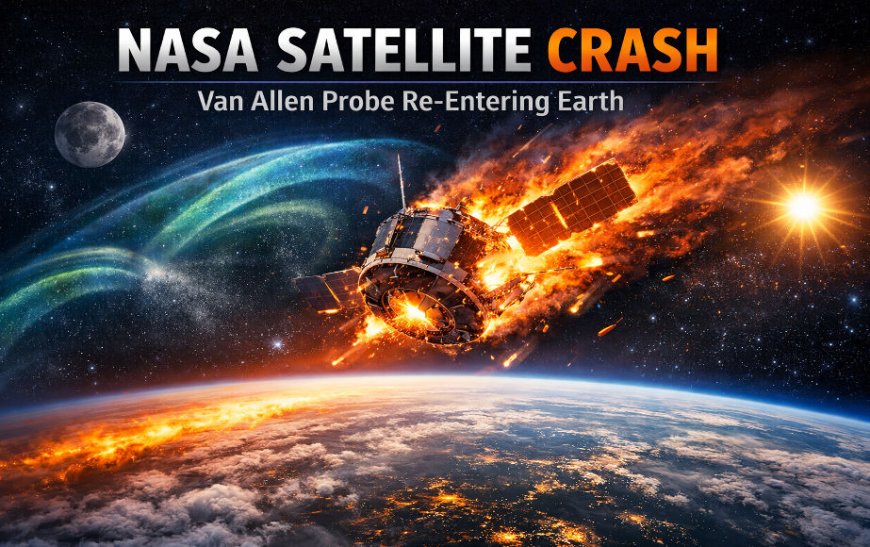
The global space science community is analysing the imminent atmospheric re-entry of an ageing research satellite that has spent over a decade examining Earth’s radiation environment. The spacecraft, designated Van Allen Probe A, was launched by NASA in 2012 to study the planet’s radiation belts and the dynamics of energetic particles encircling Earth.
News reports often characterise the event as a NASA Satellite Crash, but scientists clarify that the spacecraft is not crashing conventionally. The probe is undergoing a natural descent due to orbital decay, as atmospheric drag and heightened solar activity have steadily lowered its altitude.
Researchers expect that most of the satellites will burn up during atmospheric re-entry, meaning the possibility of debris reaching populated areas on Earth remains extremely low.
Featured Snippet: Key Facts About the Satellite Re-Entry
- Satellite: Van Allen Probe A
- Launch date: 30 August 2012
- Mission objective: Study Earth’s Van Allen radiation belts
- Weight: Approximately 600 kg (1,323 pounds)
- Mission concluded: October 2019
- Estimated re-entry: Around 10–11 March 2026
- Estimated risk of injury: About 1 in 4,200
- Expected outcome: The majority of the spacecraft will burn up in the atmosphere
Scientists note that re-entry events similar to this NASA Satellite Crash occur regularly once satellites reach the end of their operational life.
Background of the Van Allen Probes Mission
The spacecraft involved in the NASA Satellite Crash event formed part of NASA’s Van Allen Probes mission, a major scientific effort aimed at understanding the radiation environment surrounding Earth.
Two identical spacecraft, Probe A and Probe B, were launched together from Cape Canaveral using an Atlas V rocket. Their primary objective was to investigate the Van Allen radiation belts, zones of high-energy particles trapped within Earth’s magnetic field.
During the mission, researchers achieved several important scientific discoveries, including:
- Observing unexpected fluctuations in the radiation belt intensity
- Detecting the temporary appearance of a third radiation belt
- Gaining deeper insight into space weather effects on satellites
Although the mission was originally planned to last two years, the spacecraft continued operating for nearly seven years before its fuel supply was depleted.
Reasons Behind the NASA Satellite Crash
The upcoming NASA Satellite Crash 2026 is mainly linked to orbital decay, which naturally affects satellites after their missions are completed.
Three major factors contributed to the spacecraft’s gradual descent:
1. Atmospheric drag
Even at high orbital altitudes, thin traces of Earth’s atmosphere create friction that slowly pulls satellites closer to the planet.
2. Increased solar activity
Periods of strong solar radiation expand the upper layers of Earth’s atmosphere, increasing drag on spacecraft orbiting the planet.
3. Mission completion
Once the satellite’s fuel supply was exhausted in 2019, it could no longer perform orbital adjustments to maintain altitude.
Early estimates suggested the spacecraft might stay in orbit until around 2034. However, heightened solar activity accelerated the process, bringing forward the predicted NASA Satellite Crash re-entry.
When Will the Satellite Re-Enter Earth’s Atmosphere?
According to current tracking data, the spacecraft is expected to re-enter the atmosphere around 10–11 March 2026, although predictions may vary by roughly 24 hours.
Pinpointing the exact location of a NASA Satellite Crash re-entry remains difficult because satellites orbit Earth approximately every ninety minutes.
Possible outcomes include:
- Debris is falling into the Pacific Ocean or other major oceans.
- Small fragments landing in sparsely populated areas
- The spacecraft disintegrated completely during atmospheric heating.
Since oceans cover nearly 71% of Earth’s surface, most satellite debris typically ends up in water.
Is the NASA Satellite Crash Dangerous?
Despite the dramatic language often used in headlines, scientists confirm that the risk of a NASA satellite crash is extremely small.
Several factors reduce potential danger:
- Re-entry temperatures exceeding 1,500°C, which destroy most materials
- Structural fragmentation occurring at high altitude.
- Debris is scattered across large areas rather than falling in a single location.
Current calculations indicate that the probability of a person being injured by debris from the NASA satellite crash is approximately 1 in 4,200.
Historically, confirmed incidents involving space debris striking humans are extremely rare. Only one recorded case occurred in 1997 when a small fragment hit a person in the United States without causing injury.
Scientific Value of the Mission
Although the discussion centres on the NASA Satellite Crash, the mission itself produced valuable scientific results.
The Van Allen Probes improved the understanding of:
- Radiation belt behaviour during solar storms
- Interaction between solar wind and Earth’s magnetic field
- Effects of space weather on communication and navigation satellites
These insights helped scientists develop improved predictive models and protective measures for spacecraft operating in Earth’s orbit.
Data collected during the mission continues to support research into the dynamic environment surrounding our planet.
Growing Importance of Space Debris Management
The NASA Satellite Crash re-entry also highlights the broader challenge of managing space debris.
Thousands of inactive satellites and fragments currently orbit Earth. With the number of launches increasing each year, space agencies and private companies are working on strategies to ensure safer orbital operations.
Common approaches include:
- Designing satellites that burn up safely during re-entry
- Moving retired spacecraft into distant graveyard orbits
- Developing technology capable of removing large debris objects
Such measures are essential for maintaining sustainable space activity in the future.
Conclusion
The NASA Satellite Crash involving Van Allen Probe A represents the final phase of a mission that significantly expanded scientific knowledge of Earth’s radiation environment.
After spending nearly fourteen years in orbit, the spacecraft is now returning to Earth due to natural orbital decay accelerated by solar activity. While small fragments may survive the descent, the overall risk to people on the ground remains extremely low.
Rather than representing a disaster, this event marks the natural conclusion of a highly successful research mission whose discoveries continue to influence modern space science.
What's Your Reaction?
 Like
0
Like
0
 Dislike
0
Dislike
0
 Love
0
Love
0
 Funny
0
Funny
0
 Angry
0
Angry
0
 Sad
0
Sad
0
 Wow
0
Wow
0

Suresh_Sawar
I am an Author and Content Writer passionate about creating clear, engaging, and meaningful content. I enjoy turning ideas into words that connect with readers and deliver real value. My focus is always on quality, creativity, and audience-focused writing that makes an impact.