





























































































































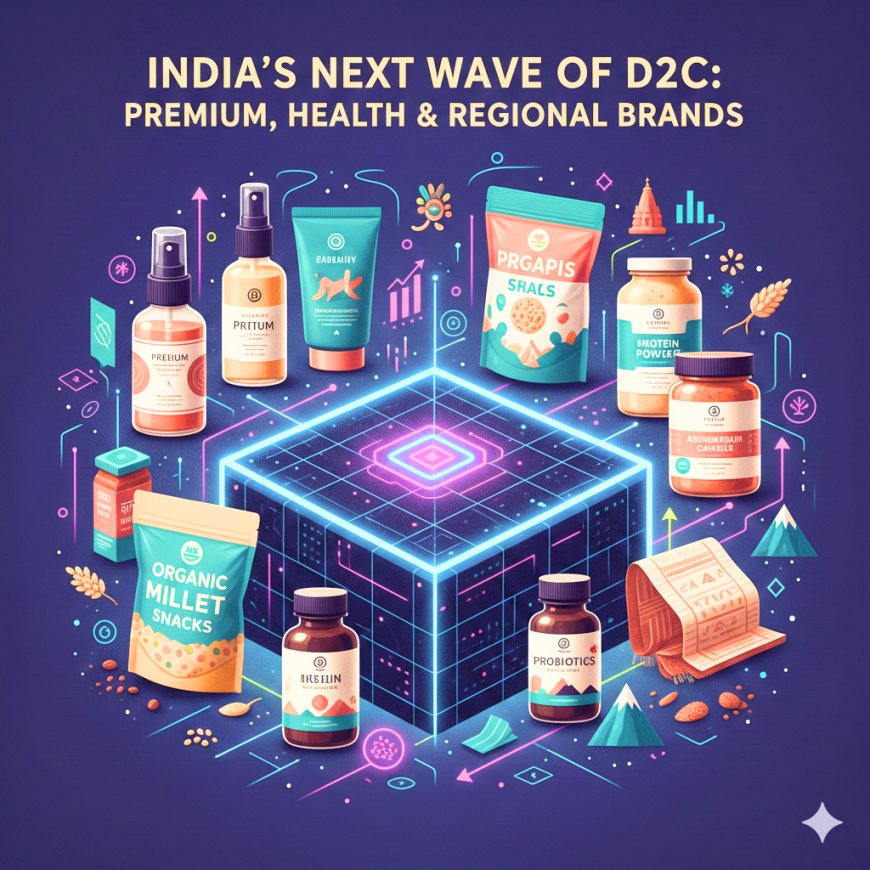
India’s Next Wave of D2C – Premium, Health & Region-Specific Brands
India’s D2C landscape is shifting toward premium, health-focused, and regionally rooted brands. This article explores the key drivers, emerging ₹100–500 crore categories, omnichannel growth strategies, and the opportunities shaping India’s next generation of consumer brands.

India’s consumer market is entering a pivotal moment — one where the traditional value-first mindset is giving way to a powerful quality-first and wellness-led consumption shift.
For the past decade, India’s D2C boom was driven largely by affordability, discounts, and convenience. But 2025 marks a clear change:
Consumers now want premium experiences, healthier ingredients, and authentic regional stories behind the products they buy.
From skincare and beverages to snacks and supplements, Indian shoppers — especially in Tier 1 and emerging Tier 2 cities — are actively seeking clean-label, functional, and region-rooted brands that feel trustworthy, aspirational, and culturally relevant.
This shift is being accelerated by:
- A more informed middle class that reads labels, checks ingredients, and understands nutrition
- Stronger digital communities discussing wellness, fitness, and region-based products
- Higher willingness to pay a premium for better quality, authenticity, and brand purpose
2025 is the new growth moment for D2C founders.
Why? Because the next generation of D2C brands won’t compete in the discount-driven mass market. Instead, they will emerge in ₹100–500 crore premium niches such as:
- Health foods & nutraceuticals
- Clean beauty & dermatology-led skincare
- High-protein snacks
- Functional beverages
- Regional FMCG rooted in heritage and local ingredients
Thesis:
India’s next wave of breakout D2C brands will be premium, wellness-first, and deeply regional — capturing the aspirations of a modern India that is richer, health-conscious, and culturally confident.
What’s Driving the New D2C Wave?
India’s D2C surge isn’t accidental — it’s driven by powerful socio-economic and cultural forces reshaping consumer behaviour.
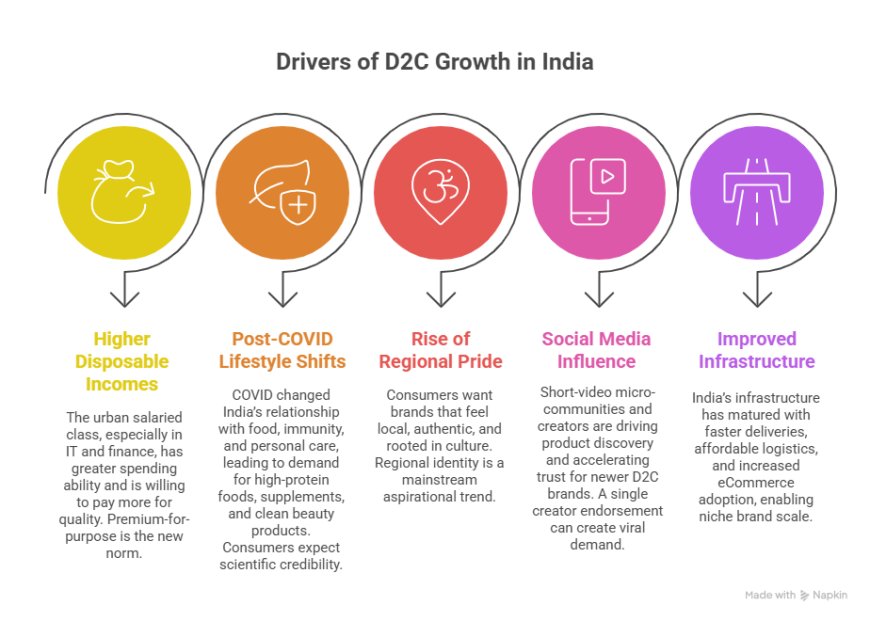
1. Urban salaried class with higher disposable incomes
India’s young workforce — especially in IT, finance, and services — has greater spending ability than ever.
They are willing to pay 20–40% more for better-quality food, skincare, fitness, and lifestyle products.
Value is still important, but premium-for-purpose is the new norm.
2. Post-COVID lifestyle shifts: nutrition, immunity, fitness
COVID fundamentally changed India’s relationship with:
- Food labels
- Immunity
- Personal care routines
- Daily wellness habits
This led to an explosion of demand for:
- High-protein foods
- Vitamin & mineral supplements
- Collagen, probiotic, and gut-health products
- Herbal & ayurvedic blends
- Clean beauty formulations
Consumers now expect brands to demonstrate scientific credibility and clean ingredient lists.
3. Rise of regional pride: local ingredients, heritage, language-driven branding
A powerful shift is underway:
Consumers want brands that feel local, authentic, and rooted in culture.
Examples of what’s trending:
- Himalayan herbs
- Kerala coconut-based wellness
- North-Eastern superfoods
- Millets
- Traditional chutneys & spices
- Region-specific snacks
- Packaging that uses local dialects
Regional identity is no longer niche — it’s a mainstream aspirational trend.
4. Influence of social media micro-cultures & creators
Instagram, YouTube, and especially short-video micro-communities have changed how trends spread.
Creators in niches like:
- Dermatology
- Functional fitness
- Ayurveda
- Regional cuisine
- Women’s health
- Homegrown fashion
… are driving product discovery and accelerating trust for newer D2C brands.
A single creator endorsement can create viral demand for a small brand overnight.
5. Logistics + eCommerce infrastructure enabling niche brand scale
India’s infrastructure has matured:
- Faster hyperlocal deliveries
- Affordable 3PL solutions
- ONDC integrations
- Tier 2 & Tier 3 eCommerce adoption
- Cashless payments through UPI
This means even niche brands with small-batch production can distribute nationally — and scale to ₹100–500 crore revenue without traditional retail.
Key takeaway of this section:
The convergence of rising incomes, health consciousness, regional pride, and digital influence has created the perfect runway for India’s next wave of premium, health-focused, and region-specific D2C brands.
Premiumisation India Is Trading Up
India is undergoing a clear shift: consumers are no longer buying the cheapest, they’re buying the best they can afford. Premiumisation is becoming one of the strongest consumer trends of the decade.
Premium categories are outgrowing mass-market segments
Across multiple sectors, premium products are growing 2–3x faster than value or mid-market categories. This is especially visible in:
· Beauty & personal care: High-performance serums, clinical actives, and dermat-tested formulations dominate online sales.
· Men’s grooming: Specialized beard care, premium fragrances, and performance-oriented skincare.
· Pet care: Holistic nutrition, grain-free food, and breed-specific supplements for dogs and cats.
· Sleep tech: Weighted blankets, premium mattresses, ergonomic pillows, melatonin blends.
· Baby care: Natural, toxin-free baby wash, lotions, and organic nutrition.
This growth is directly linked to rising incomes, exposure to global trends, and the desire for products that feel elevated, safer, and more aspirational.
Price sensitivity is declining for high-trust brands
Consumers — especially millennials and urban Gen Z — are willing to pay a premium when three conditions are met:
1. Superior product experience
2. Authentic brand story
3. Visible, proven benefits
They see premium brands not as “costly,” but as “worth it.”
Examples (generic) of fast-growing premium niches
· Luxury skincare: Retinol serums, vitamin C concentrates, peptide creams
· Boutique fragrances: Long-lasting, niche Indian perfumery with global-quality blends
· Premium haircare: Sulfate-free shampoos, scalp serums, bond-repair masks
· High-end coffee: Single-origin, artisanal blends, cold brew concentrates
As long as the brand can justify its price with quality, science, and transparency, consumers are willing to trade up — and trade up fast.
Health & Wellness D2C: The Fastest-Growing Category
If premiumisation is rising, wellness is exploding. Health-conscious consumers are reshaping demand across food, beverages, beauty, and personal care.
Categories seeing explosive demand
Functional Foods
Products fortified with vitamins, fibers, collagen, or adaptogens.
Protein-Rich Snacks
Protein bars, chips, cookies, and ready-to-drink shakes tailored for urban, fitness-aware consumers.
Low-Sugar, Gut-Friendly Beverages
Kombucha, prebiotic sodas, zero-sugar hydration drinks, electrolyte powders.
Clean Beauty & Toxin-Free Personal Care
Brands emphasizing “no parabens, no sulfates, no mineral oil,” and offering naturally active formulations.
Women’s Wellness & Hormone Health
Products for PCOS support, menstrual health, gut health, sleep, and stress management — a previously underserved space now becoming mainstream.
The trust gap in legacy FMCG = massive opportunity
Traditional FMCG brands often lack transparency — consumers are skeptical of:
· Hidden sugars
· Synthetic additives
· Generic formulations
· Mass-produced products lacking personalization
D2C brands win by being:
· Ingredient-forward
· Transparent in labeling
· Science-backed
· Backed by doctors, nutritionists, or labs
Rise of “ingredient-first” storytelling
Consumers now buy ingredients, not just brands. This has made certain ingredients mainstream in marketing:
· Collagen for skin and joint support
· Ashwagandha for stress relief
· Probiotics for gut health
· Millet for sustainable, high-fiber nutrition
· Plant protein for clean energy and fitness
By educating consumers about why an ingredient works, D2C brands are building cult followings and premium positioning.
Region-Specific Brands: India’s Hidden Goldmine
India’s greatest consumer opportunity today lies in something legacy FMCG ignored for decades — its cultural, culinary and linguistic diversity. As consumers rediscover regional identity and nostalgia, D2C brands rooted in local flavours, ingredients, and traditions are exploding across categories.
India’s Diversity → Hyperlocal Demand
With 28 states, hundreds of micro-cuisines, and deep-rooted beauty and wellness traditions, India is not a single consumer market — it’s a mosaic. Consumers increasingly seek products that reflect where they come from and what they value.
Booming Regional Consumption Themes
a) Regional Snacks
Local favourites like Murukku, Bakarwadi, Thekua, Banana Chips, Rosogolla, and Podi mixes are becoming national hits through D2C models. What was once “local bakery” food is now a scalable brand opportunity.
b) Traditional Superfoods
Ingredients like ragi, millet, gond, nolen gur, makhana, jaggery, rajgira, and local seeds/spices are powering the clean-eating movement.
c) Local Beauty Rituals
State-specific beauty traditions — ubtan mixes, kumkumadi, hibiscus oil, curry leaf hair potions, rice-water serums — are now premium D2C essentials.
d) AYUSH-Backed Formulations
Tried-and-tested remedies from Ayurveda, Siddha, and Unani medicine are seeing revival in modern packaging.
e) Artisanal Textiles & Crafts
Handlooms, block prints, ikkat, Chanderi, Bandhej, Kanchipuram silk, and regional crafts are capturing global attention through new-age D2C storefronts.
“Proudly Indian, Proudly Regional” Is a Winning Narrative
Consumers want authenticity, nostalgia, and meaning. Region-first brands naturally deliver all three. They connect emotional storytelling with origin-driven credibility.
Small-Town Creators Scaling Nationally
Thanks to Instagram Shops, ONDC, Meesho, and WhatsApp commerce:
· Local entrepreneurs can build niche brands without metros
· Hyperlocal products can reach national customers
· Micro-influencers can drive trust and discovery
Region-first is no longer small — it’s the next scalable D2C movement.
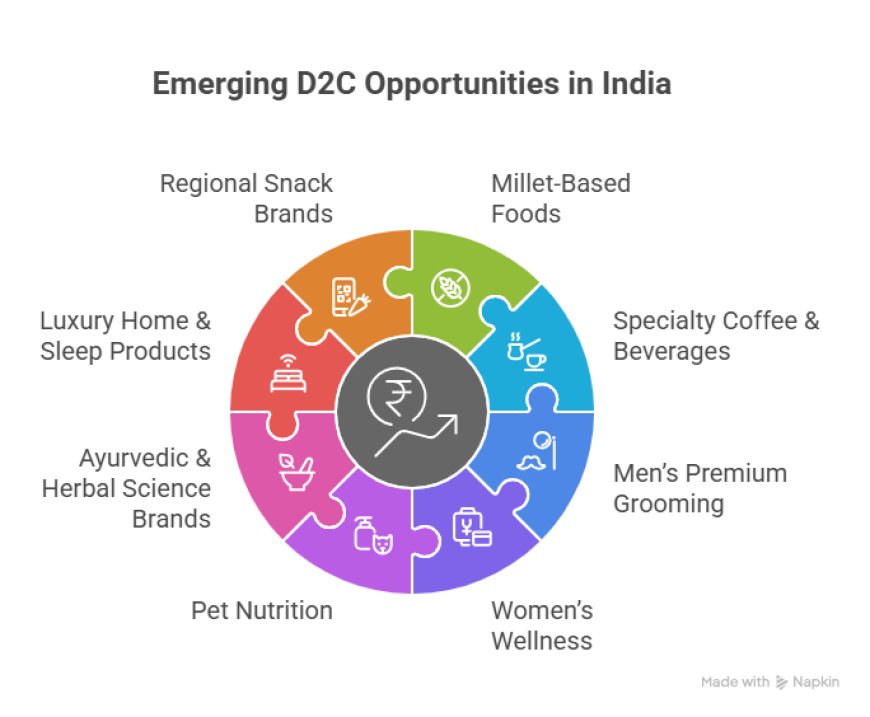
The New ₹100–500 Crore D2C Opportunities
As India shifts toward premium, wellness-driven, and regional consumption, several categories are emerging as high-margin, high-retention, scalable D2C plays. These are the spaces where the next breakout brands will be built.
Breakout Categories Poised for Scale
a) Millet-Based Foods
India’s “International Year of Millets” momentum continues.
Ready-to-eat millets, millet snacks, millet noodles, and breakfast mixes align perfectly with health + taste + affordability.
b) Specialty Coffee & Beverages
Urban India is moving from instant coffee to:
· Single-origin coffee
· Cold brews
· Premium teas
· Functional beverages
Premium pricing, strong brand loyalty, and lifestyle-led positioning make this a ₹500 crore-ready category.
c) Men’s Premium Grooming
Beard care, fragrances, skincare, haircare, and devices (trimmers, grooming tech) are exploding as urban men move beyond “basic grooming.”
High margins + aspirational positioning = massive potential.
d) Women’s Wellness
One of the fastest-growing D2C categories with strong repeat purchases:
· PMS relief
· PCOS/PCOD support
· Hormone health
· Intimate wellness
· Prenatal & postnatal nutrition
Science-backed solutions win here.
e) Pet Nutrition
Pet adoption is rising + nuclear families → booming demand for:
· High-quality dog & cat food
· Treats
· Supplements
· Grooming essentials
A ₹300–500 crore opportunity for early movers.
f) Ayurvedic & Herbal Science Brands
A fusion of Ayurveda + modern science is powering premium personal care, wellness supplements, and functional foods.
Trust + tradition + modernity = high-growth space.
g) Luxury Home & Sleep Products
Young professionals are investing in comfort and lifestyle upgrades:
· Orthopedic mattresses
· Premium pillows
· Aromatherapy
· Home fragrances
· Designer furnishings
A perfect fit for premium D2C branding.
h) Regional Snack Brands with Tech-Enabled Distribution
Regional snack brands can scale quickly with:
· Cold-chain logistics
· ONDC
· Quick commerce
· Hyperlocal influencer networks
A market with massive emotional pull and low acquisition cost.
Why These Categories Win
These emerging categories share exceptional fundamentals:
· High repeat consumption → increases LTV
· Premium margins → better unit economics
· Strong brand loyalty → lower CAC over time
· Large TAM + expanding demand → scalable to ₹500 crore
· Alignment with consumer megatrends → health, premium, regional, authenticity
These are the categories where India’s next generation of D2C leaders will emerge.
Distribution Beyond D2C → Omnichannel
India’s next wave of D2C brands is no longer built on a single-channel playbook. Pure-play D2C is becoming increasingly expensive due to rising CACs, competitive ad markets, and platform dependence. The winning brands of 2025 are those that build a multi-channel, discovery-led, trust-led distribution engine.
The Shift to Omnichannel
1. Quick-Commerce (Q-Commerce)
o Blinkit, Zepto, and Instamart are becoming high-intent discovery engines.
o Ideal for:
§ Premium snacks
§ Personal care essentials
§ Coffee and beverages
o Customers love instant gratification, and niche D2C brands gain instant visibility.
2. Modern Trade
o Retail chains like Reliance Smart, Nature’s Basket, Wellness Forever, and Shoppers Stop are onboarding fast-growing D2C brands.
o Benefits:
§ Credibility boost → Being on shelves signals trust.
§ High footfall exposure.
§ Stronger unit economics for mid-to-premium products.
3. Pharmacies & Health Stores
o Critical for:
§ Clean beauty
§ Women’s wellness
§ Functional foods
§ Nutraceuticals
o Pharmacies provide legitimacy, expert recommendation, and repeat purchase opportunities.
4. Regional Distributors
o Regional FMCG distributors are key for scaling:
§ Local snacks
§ Herbal and Ayurveda products
§ Beauty and grooming brands
o Helps penetrate Tier 2–4 markets quickly.
5. ONDC & Social Commerce
o ONDC allows small and niche D2C brands to break free from platform dependence.
o Social commerce (Meesho, Instagram Shops, ShareChat, Moj) boosts:
§ Tier 2–4 discovery
§ Community-driven trust
§ Regional brand visibility
Why Omnichannel Wins
· Offline gives credibility that digital-only brands often struggle to earn.
· Better margins due to diversified acquisition paths.
· Higher LTV because customers see the brand repeatedly across touchpoints.
· The best D2C brands of 2025 are not digital brands — they are consumer brands built on digital DNA.
What Today’s Winning D2C Brands Have in Common
Across categories—from specialty coffee to herbal science brands—D2C winners share a common playbook. Their success is not accidental; it’s structural.
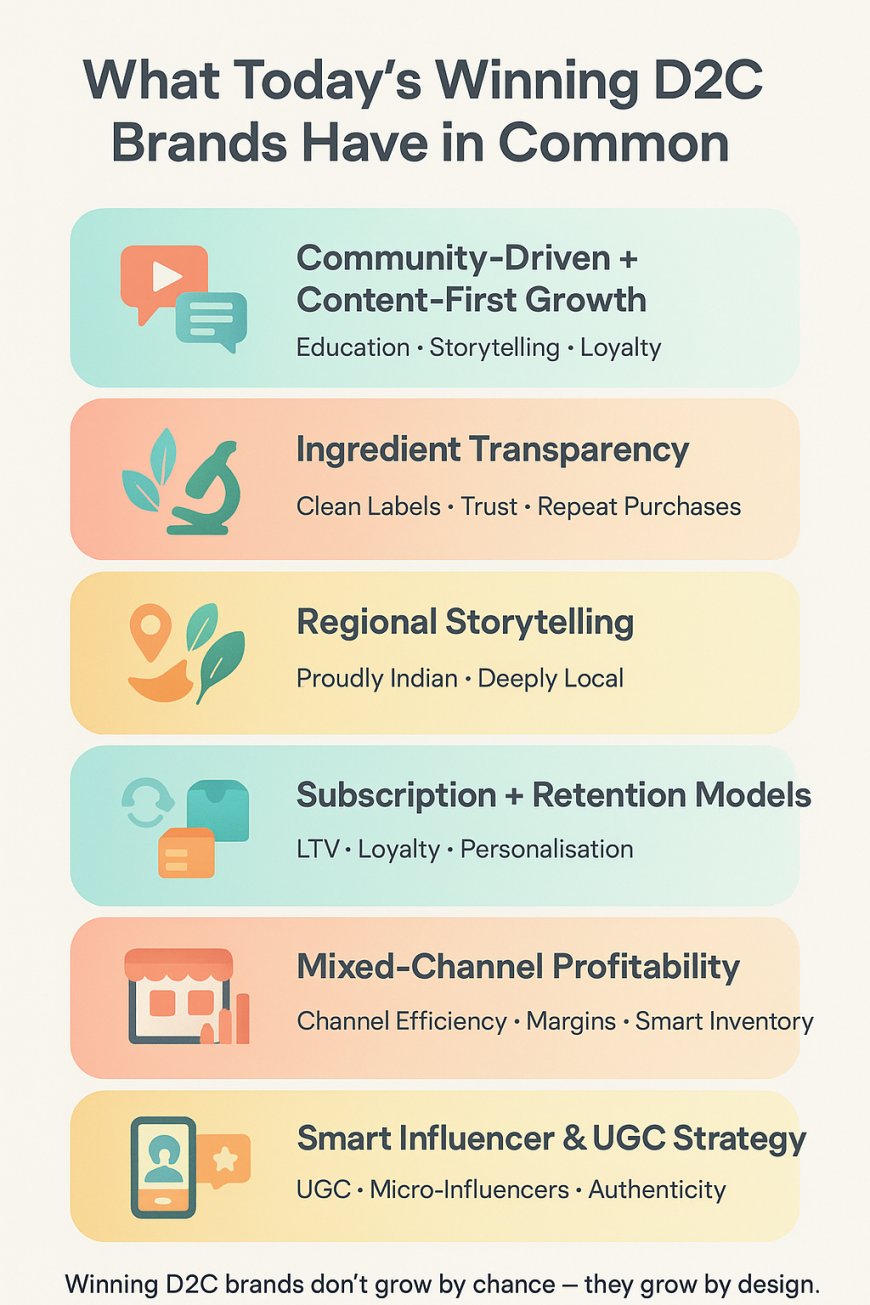
1. Community-Driven + Content-First Growth
· Top D2C brands act like media companies.
· They build:
o Educational content (ingredients, routines, rituals)
o How-to videos
o Expert-led storytelling
· Community loyalty reduces CAC and boosts referrals.
2. Ingredient Transparency & Clean Labels
· Modern consumers distrust legacy FMCG’s “secret formula” claims.
· Winning brands highlight:
o What’s inside
o Where it comes from
o Why it works
· Transparency → higher trust → premium pricing → repeat purchases.
3. Regional Storytelling
· Boldly embracing:
o Local ingredients (kokum, gondh, ragi, moringa)
o Regional snacks (bikaneri, murukku, chikki)
o Traditional beauty rituals (ubtan, hair oils, ayurvedic tonics)
· “Proudly Indian, Deeply Local” is resonating with urban and smaller-town consumers alike.
4. Subscription + Retention Models
· Winners optimize LTV through:
o Auto-delivery subscriptions
o Loyalty programs
o Bundled offerings
o Personalised recommendations
· Retention > acquisition for building ₹100–500 crore brands.
5. Mixed-Channel Profitability Focus
· They track profitability per channel, not vanity GMV.
· Strategies include:
o High-margin SKUs in offline stores
o Hero products on D2C website
o Sampling packs on quick-commerce
6. Smart Influencer & UGC Strategy
· Brands focus on:
o Micro-influencers
o Region-specific creators
o Relatable UGC (before/after, day-in-life, reviews)
· More authenticity → lower CAC → higher trust.
What Will Break or Slow Down Brands
India’s D2C market may be booming, but the road to ₹100–500 crore scale is far from smooth. Many brands stumble not because of low demand — but because of structural challenges that compound as they grow.
1. High CAC on Meta & Google
Performance marketing costs are at an all-time high.
CPMs have doubled in many categories. Click costs have surged.
For brands relying only on paid ads, profitability becomes impossible.
Winning brands diversify into:
· Organic content
· SEO
· Community-driven retention
· Influencer-led demand
· Offline channels
2. Inventory & Supply Chain Inefficiencies
D2C categories such as beauty, personal care, wellness, and food require tight control over:
· Forecasting
· Shelf life
· Cold-chain management (for beverages, functional foods)
· Packaging logistics
Missteps mean stockouts, expired SKUs, or dead inventory — all margin killers.
3. Need for Clinical Backing in Wellness Brands
With the surge in “science-backed” products, consumers expect:
· Lab testing
· Clinical trials
· Certifications
· Transparent ingredient documentation
Brands making tall claims without credible proof risk backlash, poor reviews, and distrust.
4. Offline Expansion Costs
Omnichannel is the future — but opening stores, entering modern trade, or partnering with pharmacies requires:
· Upfront capital
· Distributor margins
· Trade schemes
· Inventory rotation planning
Without financial discipline, offline expansion can sink cash fast.
5. Trust Issues if Claims Are Not Scientific
Consumers today Google everything.
If ingredients, benefits, or formulations lack scientific grounding, consumers switch brands instantly.
Trust is no longer a “brand value” — it’s a core growth engine.
6. Rising Competition & Copycats
Successful SKUs get copied within weeks, especially in:
· Beauty
· Wellness
· Food & beverages
What matters now is:
· Brand story
· Community
· Ingredient authority
Regional or cultural uniqueness
These are harder to copy than packaging or flavour.
Conclusion
India’s D2C ecosystem has matured. The early wave of low-priced, mass-producer brands is fading. The next decade belongs to labels that represent aspiration, authenticity, and trust.
The era of cheap, generic D2C is over.
Consumers now demand:
· Ingredient clarity
· Better formulations
· Regional authenticity
· Premium experiences
· Science-backed claims
The winners of 2025–2030 will be:
· Premium: High-quality products with strong brand identity.
· Health-first: Functional foods, clean beauty, wellness, and nutrition.
· Regionally rooted: Brands built on local ingredients, dialects, flavours, and pride.
· Omnichannel: Present across D2C, q-commerce, retail, pharma, and ONDC.
· Community-led: Loyal fanbases built through content, storytelling, and values.
The next generation of India’s iconic ₹100–500 crore brands is already emerging — built not on discounts or ads, but on quality, trust, and cultural resonance.
This is India’s next D2C revolution — and it’s just getting started.
Disclaimer
The insights, trends, and market opportunities discussed in this article are based on publicly available information, industry observations, and emerging consumer behaviour patterns. They are not to be interpreted as financial, investment, or business advice.
Building or scaling a D2C brand requires detailed analysis of:
· Category-specific regulations
· Competitive landscape
· Unit economics and supply-chain feasibility
· Product safety, testing, and compliance
· Consumer research and market validation
Readers and aspiring founders are strongly encouraged to conduct independent due diligence, consult industry experts where relevant, and validate assumptions before making any business or investment decisions. The author bears no responsibility for business outcomes arising from decisions made based on this content.
What's Your Reaction?
 Like
0
Like
0
 Dislike
0
Dislike
0
 Love
0
Love
0
 Funny
0
Funny
0
 Angry
0
Angry
0
 Sad
0
Sad
0
 Wow
0
Wow
0