

















































































































































How AI Personalization Is Transforming Retail, Banking and EdTech in India
India’s next digital growth wave will be powered by AI-driven personalization across retail, banking, and EdTech. With 900M+ diverse consumers, hyperlocal AI models tuned to Indian languages, behaviors, and micro-segments are becoming the biggest conversion lever for brands. This article explores the opportunities, challenges, and future of India-native personalization engines.


India has entered a new phase of digital consumption. With 900M+ internet users, interacting across dozens of languages, income levels, cultural clusters, and regional identities, India isn’t just one market — it’s hundreds of micro-markets operating simultaneously.
This is exactly why generic global AI models fail. They aren’t trained on India-specific behaviour, languages, buying patterns, or festival-driven consumption cycles. They assume uniformity — while India’s consumers behave very differently based on region, tradition, climate, and price sensitivity.
Which is why we’re seeing the rise of hyperlocal AI personalization engines designed specifically for India. These new systems can interpret Hinglish chats, decode regional buying signals, adapt to fluctuating demand patterns, and understand the nuances of how Indians shop, learn, and bank.
And with every interaction happening online — browsing, payments, credit, shopping, streaming — the volume of behavioural signals has exploded.
Thesis:
AI-driven personalization is no longer a “nice-to-have.” It is the single biggest conversion lever for Indian consumer businesses in retail, banking, and EdTech. Companies that master this will see higher engagement, lower churn, deeper personalisation — and outsized growth.
The India Advantage: Unique Consumer Signals
India is producing some of the richest, most diverse, most contextual training data in the world. This comes from:
• Multilingual Interactions
Users switch seamlessly between:
- Hindi
- Tamil
- Bengali
- Marathi
- Telugu
- Malayalam
- Hinglish
- and hyperlocal dialects
AI models must understand language mixing, accents, blended scripts, and informal speech patterns — something generic global models cannot do.
• Micro-Segmented Purchasing Patterns
India’s consumption varies dramatically across:
- Regions (North vs South vs East vs West)
- Income groups
- Weather zones
- Cities vs Tier 2–4 towns
- Festive cycles
- Cultural preferences
AI needs to pick up these micro-trends to deliver relevant products, offers, and content.
• UPI & Digital Payments = Behavioural Intelligence
UPI and digital wallet usage generates unparalleled signals:
- Spending frequency
- Category-level preferences
- Risk profiles
- Seasonal changes
- Savings vs impulse purchase patterns
This gives Indian companies a massive edge in training granular personalization models.
• Social Commerce + Short-Video Culture
India’s user intent is now shaped by:
- Instagram Reels
- YouTube Shorts
- Moj
- ShareChat
- Influencer-driven micro-communities
Consumers often discover products visually and emotionally — and AI needs to decode these behaviour shifts.
Why India’s Ecosystem Produces Better Training Data
India’s diversity, scale, and multilingual behaviour create data patterns that are:
- Deeply contextual
- Highly dynamic
- Regionally distinct
- Emotionally expressive
This provides a powerful foundation for AI personalization models that outperform global counterparts in the Indian market.
AI in Retail: Hyper-Personalisation at Scale
Retail is where India-first AI personalization is already transforming outcomes.
AI systems now tailor:
- Product recommendations
- Discounts and pricing
- Search results
- Bundles
- Content
- Delivery promises
…based on local price sensitivity, geography, past behaviour, festivals, and personal preferences.
• Local Price Sensitivity as a Personalization Layer
AI can adjust:
- Recommended products
- EMI options
- Combos
- Discounts
…based on a user’s unique affordability band — improving conversions without destroying margins.
• AI-Based Demand Prediction for Kirana + eCommerce
AI predicts:
- Local festival spikes
- Weather-related consumption (winter creams, summer drinks)
- Regional food preferences
- Daily essentials demand
This helps stores and eCommerce players reduce stockouts and wastage.
• Region-Specific Catalogs
AI dynamically builds catalogs that vary by:
- Climate (winter wear vs coastal wear)
- Festivals (Onam vs Durga Puja vs Pongal)
- Cuisine (North vs South preferences)
- Fashion tastes (urban vs small-town trends)
Practical Examples (Generic):
- Recommendation engines adapting to Tier 2–4 trends
- AI predicting the right size/fit based on region-specific body profiles
- Virtual try-on systems that understand Indian skin tones, jewellery types, and ethnic wear
- Conversational shopping assistants that speak local languages
Results Delivered:
- Higher conversion rates
- Improved product discovery
- Lower return rates
- Increased average order value (AOV)
Better customer satisfaction
AI in Banking: Personalised Finance for a Diverse Nation
India’s financial ecosystem is both vast and deeply diverse — from first-time UPI users in Tier-3 towns to affluent urban investors. Traditional, one-size-fits-all banking experiences cannot capture this spectrum of behaviours. This is where AI-powered personalization is transforming the sector.
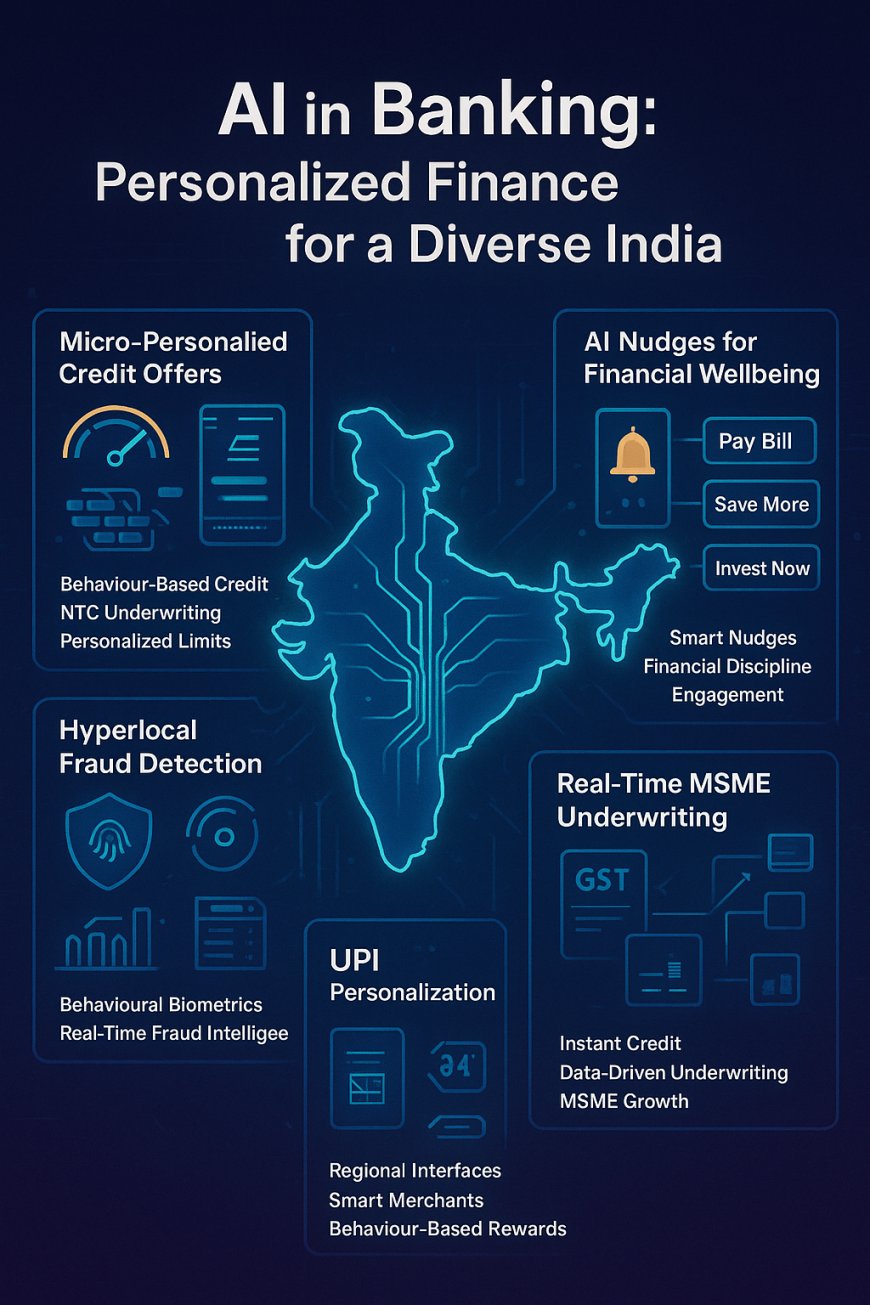
Micro-personalized credit offers
Instead of relying solely on bureau scores, banks and fintechs are now using:
- Transaction behaviour
- UPI frequency
- Repayment consistency
- Income inflow patterns
- Device-level signals
AI models evaluate thousands of micro-behaviours to generate personalized credit limits, especially for New-to-Credit (NTC) customers.
AI nudges for financial wellbeing
Banks now use behavioural AI to deliver:
- Smart nudges for bill payment reminders
- Save-more recommendations
- Personalized investment suggestions
- Alerts for overspending patterns
These nudges boost financial discipline and deepen customer engagement.
Hyperlocal fraud detection
AI-powered behavioural biometrics track:
- Typing speed
- Touch pressure
- Device posture
- Login patterns
- UPI usage anomalies
Hyperlocal fraud intelligence is essential in India’s fast-growing payments ecosystem.
UPI personalization
UPI apps now tailor:
- Language interfaces
- Spend categories
- Merchant suggestions
- Cashback recommendations
All based on usage behaviour and regional preferences.
Real-time MSME underwriting
AI uses:
- GST filings
- Invoice cycles
- Transaction flows
- Purchase orders
- Inventory patterns
…to underwrite MSMEs instantly, enabling faster credit disbursal.
Why personalization matters in a compliance-first environment
RBI’s tightening has made trust the most important differentiator.
Personalized experiences create transparency, build credibility, and strengthen retention — while staying aligned with data governance norms.
AI in EdTech: Adaptive Learning for India’s Classrooms
India’s education needs vary drastically — languages, learning speeds, school infrastructure, and student exposure. AI is enabling EdTech platforms to deliver deeply personalized learning journeys.

AI tutors adapting to each student
Instead of fixed lesson plans, AI adapts based on:
- Learning pace
- Accuracy patterns
- Attention span
- Language preferences
- Emotional cues (in advanced systems)
These adaptive pathways make learning more effective and less stressful.
Personalized quiz paths & revision plans
AI identifies:
- Topic mastery
- Weak concepts
- Memory retention gaps
- Question-solving behaviour
It then creates personalized quizzes and revision schedules, improving exam outcomes.
Vernacular-first EdTech
AI voice + language models make learning accessible via:
- Hindi, Tamil, Telugu, Marathi, Bengali, Kannada
- Hinglish and regional dialects
- Voice explanations for low-literacy households
This dramatically expands EdTech adoption in Bharat.
AI for exam prep
For JEE, NEET, SSC, UPSC and state exams, AI identifies:
- Micro-weaknesses
- Topic-specific probability of errors
- Time-management risks
Then it tailors practice modules to maximize improvement.
Predictive drop-off analytics
AI flags students who are:
- Losing engagement
- Falling behind
- Showing burnout signals
EdTech platforms can intervene early — reducing churn and improving outcomes.
How personalization improves outcomes
- Better comprehension
- Higher retention
- Reduced dropout rates
- More affordable learning
- Tailored progress tracking
AI makes learning scalable, equitable, and deeply student-centric.
The Technology Behind India-Specific Personalisation
Personalization at India’s scale requires powerful, locally tuned AI technologies.
LLMs trained on Indian languages & accents
Models fine-tuned on:
- Hindi, Tamil, Telugu, Bengali, Marathi, Gujarati & more
- Hinglish & code-switching
- Local idioms, cultural context, and slang
This ensures natural, relevant, culturally aware user experiences.
Advanced recommendation engines using India-specific signals
These models incorporate:
- Behavioural data
- Price sensitivity patterns
- Geo-specific festivals & climate
- Seasonal purchase cycles
- Income-based segmentation
This creates highly accurate, high-conversion recommendations.
Vision AI for retail catalogs
Used for:
- Product tagging
- Size recommendations
- Auto-classification in marketplaces
- Visual similarity-based suggestions
All optimized for India’s diverse catalog formats.
Real-time ranking systems
Built to work efficiently even in:
- Low-bandwidth regions
- Budget smartphones
- Rural network zones
This keeps personalization accessible across Bharat.
Secure data pipelines aligned with DPDP
India-focused AI stacks now include:
- Encryption at rest and transit
- Consent-managed data access
- Privacy-preserving ML (PPML) methods
- Federated learning for sensitive data
- Data minimization principles
These frameworks balance personalization with strict compliance and user trust.
What’s Holding Mass Personalisation Back
Despite the enormous potential of AI personalization in India, the path to nationwide scale is not straightforward. Several structural and operational barriers continue to slow down adoption.
a) Data Quality Inconsistency Across Businesses
Most Indian consumer businesses — especially in retail, banking partnerships, and EdTech — still operate with fragmented, inconsistent, or siloed data.
- Missing fields
- Non-standardized formats
- Poor integration between online and offline touchpoints
This weakens the foundation required for AI models to work reliably.
b) Lack of Well-Labelled Local-Language Datasets
India’s linguistic diversity is unmatched — but high-quality training datasets in Hindi, Tamil, Telugu, Bengali, Marathi, and 10+ other languages are still scarce.
This limits the performance of LLMs and recommendation engines that must understand:
- Code-mixed speech (Hinglish, Tanglish)
- Local idioms
- Regional purchasing behaviour
Without strong vernacular datasets, personalization suffers.
c) Risk of Algorithmic Bias in Sensitive Sectors like Lending
AI models trained on incomplete or skewed data can unintentionally reinforce bias.
In lending, this could mean:
- Penalising certain geographies
- Misjudging informal-income consumers
- Incorrectly classifying risk for new-to-credit users
Given RBI’s increasing focus on fairness, AI bias has become both a compliance and reputational risk.
d) High Compute Cost for Real-Time Inference at Scale
India’s personalization needs happen at massive volumes:
- Millions of UPI transactions per minute
- Real-time recommendations for eCommerce and quick-commerce
- Instant credit risk scoring
Real-time inference across billions of events demands expensive compute infrastructure — a challenge for mid-sized companies.
e) Stricter Compliance Requirements: Privacy, Consent & DPDP Act
The Digital Personal Data Protection (DPDP) Act mandates:
- Explicit consent
- Clear purpose limitation
- Secure data processing
- Strict data retention standards
This forces companies to re-architect their data pipelines. One misstep can lead to penalties and loss of consumer trust.
f) Consumer Mistrust If Personalisation Feels Intrusive
Indian consumers appreciate relevance — but dislike over-targeting.
If personalization crosses the line into “creepy,” it triggers:
- Opt-outs
- App uninstalls
- Negative sentiment on social media
The challenge is finding the sweet spot between value and overreach.
The Rise of India-Tuned Personalisation Engines
India is moving toward a new era where personalization becomes intelligent, multilingual, compliant, and deeply contextual to Indian behaviour.
a) Multilingual AI Super-App Assistants
Next-gen AI agents will speak:
- Hindi, Hinglish
- Tamil, Telugu
- Bengali, Marathi
- Kannada, Malayalam
—and adapt to accents, slang, and cultural cues.
These assistants will guide shopping, banking decisions, learning paths, and customer support.
b) Hyper-Personalized Commerce Powered by ONDC + UPI + AI
The convergence of:
- ONDC (catalog + logistics + local commerce)
- UPI behavioural data
- AI recommendation systems
…will create deeply personalized buying journeys for consumers in every state and district.
c) AI Copilots for Shopping, Banking, Learning & MSME Decisions
Businesses will embed AI copilots into:
- Retail apps → product discovery, size prediction
- Banking apps → financial planning, credit insights
- EdTech platforms → adaptive study paths
- MSME dashboards → cashflow forecasting, GST nudges
These copilots will become the primary interface for millions.
d) Open-Source India Datasets Enabling Ecosystem Innovation
Growing initiatives to create and release India-focused datasets will dramatically raise innovation velocity:
- Local-language speech
- Region-specific purchasing patterns
- Image datasets for Indian products, foods, apparel
- UPI-style transaction patterns (anonymised)
This will democratize access for startups.
e) Cross-Sector Personalisation: Retail → Banking → Education → Health
The next frontier is unified personalization that follows a consumer across categories — responsibly and with consent.
For example:
- Health data → personalized nutrition products
- Commerce history → tailored credit offers
- Learning behaviour → AI-driven career guidance
This 360° personalization will define the next generation of Indian consumer experience.
Conclusion
India’s digital ecosystem has outgrown one-size-fits-all customer experiences. With 900M+ online consumers across languages, regions, incomes, and cultural contexts, personalization is no longer an optional feature — it is the core growth engine.
Companies that build India-native personalization systems — rooted in local languages, rich behavioural data, privacy compliance, and real-time AI models — will see higher conversions, stronger retention, and deeper trust.
The winners of the next decade across retail, banking, and EdTech will be those that:
- Understand India’s complexity
- Build AI tuned to Indian signals
- Operate ethically and transparently
- Deliver hyper-personalized value at scale
AI personalization is not just technology.
It is India’s new competitive moat — and the businesses that embrace it early will define the next generation of market leaders.
What's Your Reaction?
 Like
0
Like
0
 Dislike
0
Dislike
0
 Love
0
Love
0
 Funny
0
Funny
0
 Angry
0
Angry
0
 Sad
0
Sad
0
 Wow
0
Wow
0